
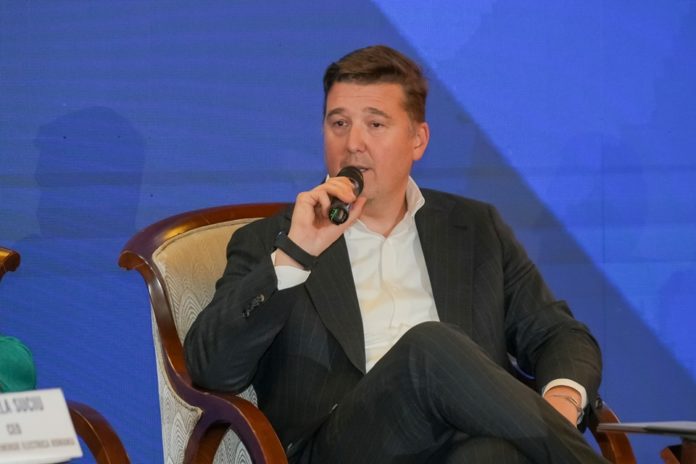
Romania’s electricity grids will need to become more digitalized, flexible and decentralized as the country’s energy transition accelerates, according to Ondrej Safar, Country Manager of Evryo Group and CEO of Distribuție Energie Oltenia.
Speaking at the Energy CEO Forum organized by The Diplomat-Bucharest, Safar outlined his vision for the future of Romania’s energy system, emphasizing the need for significantly higher investment levels to support growing electrification and the rise of distributed energy generation.
“If we look at the longer-term horizon, we are talking about a system that will be digitalized and completely rebuilt because energy flows have already started to change significantly and will become even more different in the future,” said Safar.
“The importance of electricity in the energy mix consumed by our customers will continue to increase. The network will become much more flexible. In some cases, it may even be used less than today because a significant share of energy will be produced and consumed locally, in the same area or city where it is generated. This will fundamentally change both our network and our role.”
According to Safar, while the core mission of distribution operators will remain unchanged, the way they operate will undergo a profound transformation.
“Our role will be very different, yet at the same time exactly the same as it is today. Our responsibility is to ensure that every customer has access to electricity 24 hours a day, 365 days a year. That mission remains unchanged, but the activities required to achieve it will be completely different,” he said.
The executive stressed that distribution operators are already investing heavily, supported by European funding, but current investment levels are still insufficient to keep pace with the speed of the energy transition.
“We are investing and we continue to invest. However, it is fair to say that the level of investment required and the speed at which these changes are taking place are significantly greater than what current methodologies allow us to invest,” Safar noted.
“Today, with the support of European funds, we are investing substantially more than we have ever invested historically. But it is still not enough. We need to double these investments if we want to keep pace with the changes underway, and that represents a major challenge.”
Safar also called for a broader public debate about the relationship between investment and long-term energy affordability, arguing that underinvestment has contributed to higher energy costs over time.
“As an energy sector, we need the courage to tell people that if we want energy to become cheaper and more competitive, we must invest. These investments will have costs in the short term, but they will generate benefits in the future,” he said.
“Romania has never really had the courage to make this argument. The focus has always been on cheap energy today. For the past 20 years, we have prioritized immediate affordability, and we have ended up becoming one of the most expensive energy markets in Europe precisely because of that focus.”
Without sustained investment, Romania risks losing competitiveness and failing to modernize its energy infrastructure, he warned.
“If we do not invest, we will remain among the countries with the highest energy costs in Europe, and we will never change that situation. We need the courage to invest today and ensure that those investments are used efficiently.”
At the same time, Safar highlighted the rapid growth of Romania’s prosumer segment as one of the country’s most encouraging recent developments.
“If there is one particularly positive development in Romania’s energy sector over the last few years, it is the growth in the number of prosumers. This is an extremely positive trend,” he said.
“We see that people want to generate electricity in their own homes and that they are open to adopting new technologies. We need courage, openness and efficiency throughout the entire energy value chain if we want to fully capitalize on this opportunity.”
Safar concluded that Romania’s energy transition will depend not only on technological change and investment, but also on the willingness of all stakeholders to embrace a long-term vision for the country’s energy future.