
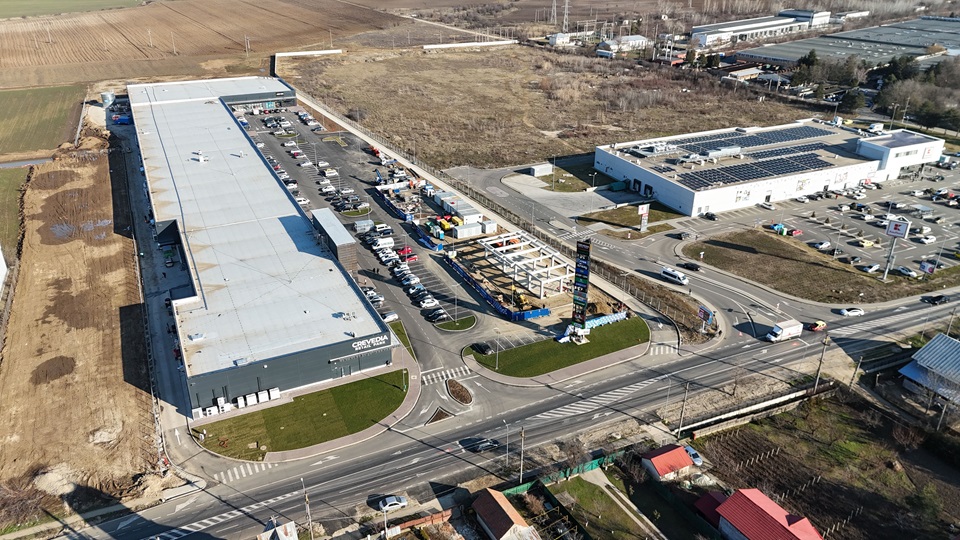
Romania’s modern retail market exceeded the 5 million square meters milestone in 2025, following the delivery of approximately 190,000 square meters of new retail space, around 20 percent above the average of the past five years, according to Colliers’ annual report. After a decade of rapid growth, the market enters a consolidation phase in 2026 amid a more moderate economic environment, but with robust deliveries estimated at around 240,000 square meters. Even so, Romania continues to have less modern retail space per capita than other markets in the region, indicating additional medium-term development potential, particularly in regional cities.
The most significant delivery in 2025 took place in Iași, where Mall Moldova, developed by Prime Kapital / MAS REI, was extended, adding approximately 59,000 square meters of modern retail space to the local stock following the refurbishment of the former Era Shopping Center. In Arad, the Agora Mall project, with a leasable area of 35,000 square meters, also returned to the market after an extensive refurbishment process and was re-included in the modern retail stock, after a period during which the centre had been closed. In addition, following a recalculation of the national stock that included older projects renovated and brought back into the modern retail offering, Romania’s total modern retail stock officially surpassed the 5 million square meters threshold in 2025.
Although small-scale retail parks continue to emerge, these are not included in official statistics, which track only projects with a minimum gross leasable area of 4,000 -5,000 square meters. Even so, such projects highlight investors’ interest in expanding retail networks in small and medium-sized cities, where demand remains active.
From a demand perspective, 2025 was more subdued compared with the very strong performance of the past five to ten years, amid a temporary decline in purchasing power and a slowdown in consumption towards the end of the year. Real wages fell by approximately 5% as of November 2025 compared to November 2024, while non-food retail sales were 3% lower in November compared with the same month of 2024. Nevertheless, this remains a short-term adjustment, given that Romanians’ purchasing power has increased significantly over the past decade and Romania continues to rank among the EU’s leading retail markets by volume, including above pre-pandemic levels.
“Overall, 2025 was a balanced year for the retail market, with deliveries across the country and a clear diversification of retail formats. This context marks a period of adjustment after a decade of good growth, without altering the market’s overall direction. Even in a more cautious environment, Romania’s modern retail sector remains well supported, and interest in expansion continues, with a clearer focus on efficiency, well-positioned locations and projects tailored to a more value-conscious consumer”, explains Simina Niculiță, Director | Partner | Retail Agency, Colliers Romania.
This stability is also reflected in labour market dynamics. Although the pace of hiring slowed in 2025, the number of employees declined by less than 1%, and companies have not announced significant workforce reductions, supporting a relatively stable level of consumption.
In 2025, several new brands entered or began expanding in the Romanian market. Among the most visible were Sports Direct, Action and Wendy’s, which opened their first stores last year, while 2026 will see new entrants such as BIPA, Lululemon and Mr. D.I.Y. At the same time, physical stores slightly outperformed online retail: non-food sales increased by 3.5% in the first 11 months of 2025, compared with growth of just 0.3% online. Against the backdrop of inflation and economic uncertainty, consumers have become more price-sensitive, favouring discount formats amid intensifying competition, including from international online retailers.
“Shopping centres maintained high occupancy levels in 2025, and new projects were generally well absorbed by the market, including in smaller cities. Dominant malls continue to have limited availability and waiting lists for tenants, allowing them to continually optimize their tenant mix and support rental growth. High occupancy rates, the strong performance of dominant centres and sustained interest from international brands confirm the market’s attractiveness over the medium and long term. In 2026, we expect discounters and essential categories such as FMCG to remain the most active, while developers will continue to deliver projects adapted to a more value-conscious consumer focused on the quality-to-price ratio”, adds Liana Dumitru, Director, Retail Agency, Colliers.
For 2026, Colliers’ consultants anticipate a more measured market pace, with more prudent decision-making from both developers and retailers. Even so, deliveries of approximately 240,000 square meters of new retail space are expected, potentially making 2026 the most active year in this respect since 2011. Announced projects vary in size, ranging from 4,000 to 20,000 square meters, and are being developed by investors active across multiple sectors, with diverse investment profiles, both local and international. Although construction costs remain elevated, the long-term outlook for Romania’s retail market remains favourable.