
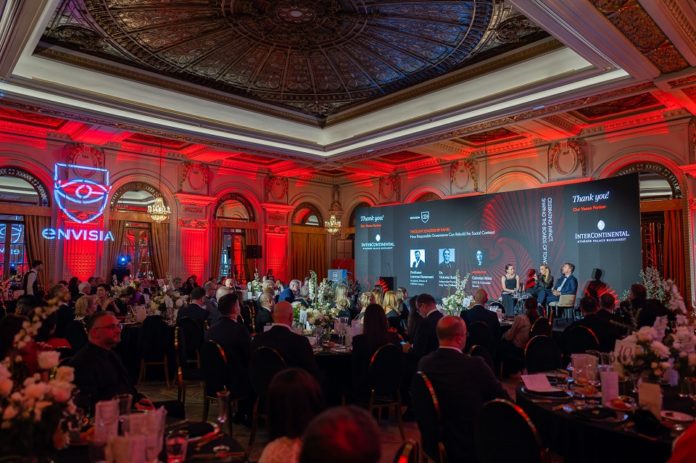
At the 2025 Future of Boards Awards Gala, Envisia brought together global voices to reimagine the purpose of governance — beyond compliance and profit, toward wellbeing, trust, and long-term value creation.

The Future of Boards Awards Gala 2025 began with a powerful moment of dialogue. Before the celebration of board excellence, the audience witnessed a conversation that questioned the very foundations of leadership and governance.
Moderated by Carmen Micu, CEO and Co-Founder of Envisia, the Thought Panel united two leading international thinkers — Dr. Victoria Hurth, independent researcher and global expert in sustainable governance, and Professor Lorenzo Fioramonti, Academic Director of Nativa Campus and former Italian Minister of Education.
Together, they explored how governance can evolve from a system of control into a framework for societal regeneration — where business and public institutions alike pursue wellbeing as their ultimate purpose.
The courage to lead toward a future that does not yet exist
Dr. Victoria Hurth opened the discussion with a compelling challenge to the status quo. Leadership, she argued, means having the courage to shape a future that is still undefined — and to do so collectively.
“To lead means to lead toward a future that doesn’t yet exist,” she said. “And if we are not clear, and collectively clear, on what that future should look like, we remain trapped in the status quo. And the status quo is the problem.”
Dr. Hurth’s presentation offered a concise yet systemic view of what governance truly is: the architecture of decision-making. Every system is governed — whether consciously or not — and the role of leadership is to ensure that governance serves what is genuinely valuable.
She reminded the audience that, in essence, governance rests on three interdependent dimensions: direction, oversight, and accountability. “If direction is wrong,” she explained, “oversight and accountability only make us better at doing the wrong thing.”
Drawing on the five-year development of ISO 37000, endorsed by 164 countries, she underscored a global consensus: the ultimate goal of governance and economics alike should be long-term wellbeing for all.
“Money,” she said, “must always remain a means — never the end in itself. The real measure of performance is whether our systems deliver long-term wellbeing for people, for planet, and for generations to come.”
Her argument positioned governance as the most powerful design tool available to humanity: the mechanism through which organizations — public or private — decide what matters and how value is created.
Reclaiming direction: a new compass for leadership
Building on this framework, Professor Lorenzo Fioramonti grounded the discussion in lived experience. Using a metaphor from sailing, he captured the essence of today’s leadership crisis:
“The first thing you learn as a sailor is to chart your route — to know where you are going. Most leaders today know every knot, every engine, every detail of operation. But if you ask, ‘Where are we headed?’ very few can answer.”
In his view, this absence of direction lies at the heart of global social and environmental breakdown. For too long, he argued, growth has been measured by accumulation — more production, more consumption, more output — regardless of the human or ecological cost.
“When development becomes about having more, not being better, we lose the social fabric that makes us human,” he said. “True progress is the ability to build wellbeing — to create communities that are healthy, cohesive, and resilient.”
Fioramonti’s Wellbeing Economy framework calls for governments, boards, and investors to redefine success itself — moving from GDP and quarterly metrics toward indicators that capture purpose, equity, and quality of life. “Economies should serve life,” he concluded, “not the other way around.”
Governance as a new social contract
In her role as moderator, Carmen Micu brought the global perspective home — situating the debate within Romania’s context of rapid transformation and institutional reform.
She pointed to the country’s ongoing modernization of public governance, the OECD accession process, and the renewed public debate around integrity and long-term national strategy as signs that Romania, too, is “ready to redesign.”
“Our governance frameworks have reached their limits,” she said. “Beyond oversight and compliance, what we need now is vision — the ability to redesign systems so that they serve life, not just efficiency.”
Carmen Micu emphasized that this re-design begins with education and dialogue. Governance, she reminded the audience, is not abstract — it is practiced daily in the decisions of boards, executives, and public leaders. When guided by ethics and insight, these decisions rebuild the trust that societies depend on.
The exchange of ideas on stage reflected exactly what Envisia stands for: education that bridges theory and practice, and governance that elevates both performance and purpose.
Takeaways for Romanian boardroom leaders
The discussion resonated strongly with the Romanian board community present in the room — chairs, CEOs, policymakers, and investors. Several key insights emerged:
- Boards must reclaim purpose — aligning financial outcomes with a wider definition of value and societal contribution.
- Governance must evolve into foresight — anticipating systemic risks and integrating environmental and social considerations into every decision.
- Education is a strategic enabler — professionalizing boards is essential to Romania’s sustainable development and OECD integration.
- Trust is designed, not declared — transparency and participation in governance processes build the confidence that sustains economies.
Closing reflection
The Thought Panel framed the evening’s theme — Celebrating Impact, Shaping the Boards of Tomorrow — as both aspiration and responsibility. It showed that governance is not merely a framework of control, but a creative act: the capacity to design better systems, stronger communities, and a more meaningful economy.
As Dr. Hurth concluded, governance determines “the quality of our decisions and, ultimately, the quality of our collective life.” And as Professor Fioramonti reminded the room, purpose is not a slogan, but a compass.
For Envisia and the leaders gathered that night, the message was clear: the future of governance will be defined not by compliance, but by conscience — and by the courage to build prosperity through purpose.
The event was made possible thanks to the partners who share Envisia’s vision for responsible leadership:
Visionary Partners — BRD Romania, ProTV
Ally Partners — Electrica SA, Transgaz
Contributor Partners — SAI Muntenia Invest, RomGaz, Ursus Breweries, Regina Maria, Evergent Investment, Moore Romania, Raiffeisen Bank, Adrem, Patria Bank, Electrocentrale Borzești, Returo
Institutional Partners — Bucharest Stock Exchange, General Secretariat of the Government, Family Business Network, Romanian Association of Fund Managers, Aspen Institute Romania, British-Romanian and French-Romanian Chambers of Commerce, ROREG – Association of Regional Development Agencies, ROPEA
Venue Partner — InterContinental Athénée Palace, part of the Ana Hotels Group
Creative Partners — InterAct, Future Station, Public Affairs Solutions, Enache Pirtea & Asociații, Positive Communication
About Envisia
Envisia is the first business school in Central and Eastern Europe dedicated to the professionalization of board members and governance leaders.
Its mission is to cultivate responsible leadership at the highest level — supporting chairpersons, non-executive directors, and senior executives to lead with purpose, ethics, and long-term vision.
Through accredited postgraduate programs, professional certifications, and international partnerships with Henley Business School – University of Reading (UK), the Romanian-American University, and other prestigious institutions, Envisia develops the competencies, discernment, and vision needed to navigate today’s complex governance landscape.
More details at www.envisia.eu.