
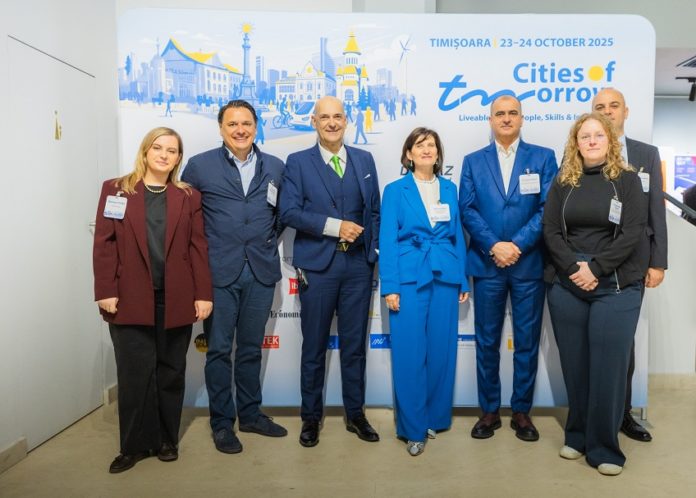
To provide a higher quality of life, cities must adapt to climate change, but also to current geopolitical changes, to capitalize, through innovation, on existing resources, contributing, at the local level, to the overall resilience of the country. This is what makes a city “liveable”, bringing together people, skills and innovation.
The AHK Romania’s “Cities of Tomorrow” conference chose for this year the theme Liveable Cities: People, Skills & Innovation.

Organized in collaboration with the Timișoara City Hall and Visit Timișoara between 23-24 October, the event provided an appropriate framework for the exchange of good practices between cities from Austria, Switzerland, Germany and Romania – an open dialogue on effective urban policies, public-private partnerships and development models that can inspire the sustainable transformation of cities in Romania.
“Cities of Tomorrow wants to show that the development potential of a country is not only in the capital, but also in other cities. We want to discuss what “liveable cities” really mean, communities that offer a good quality of life, modern infrastructure and efficient services, but also how, especially in the current, extremely volatile context, cities can become more resilient in the face of geopolitical, economic, climate and technological challenges. Local communities have valuable resources, innovative ideas and dedicated leaders, which can significantly contribute to creating more attractive, resilient and connected cities. They must face current geopolitical and economic challenges, such as labor migration, pressure on resources or adaptation to climate change. The solutions are found through regional cooperation, local innovation and a closer connection between the administration, the private sector and society,” said Sebastian Metz, the general director of AHK Romania, at the opening of the conference.
One of the great challenges of public administrations is to avoid inertia and maintain the focus on citizens, according to the Mayor of Timișoara, Dominic Fritz, who was present at the event. The ability to innovate and try new things is another obstacle, as it involves assuming potential mistakes, which have a political cost for mayors. “We are trying to break this vicious circle here, in Timișoara, because for some time, more precisely in the last five years, we have attracted over 350 million euros for many projects on European funds, primarily on urban mobility, for the renewal of the public transport fleet, but also for schools or kindergartens. We are also the most digital city hall in the country and this is because we have managed in the last three years to digitize the entire document and bureaucratic process,” said Dominic Fritz.
The attention paid by the authorities to the citizens of Timișoara was also noted by the Consul of the Federal Republic of Germany in Timișoara, Anja Zougouari: “The heart of a city is not represented by its buildings or documents, but by its people – their ideas and skills, their desire to get involved and the courage to bring about change. Since arriving in Timișoara, I have been impressed by how vibrant, young and fresh the city feels. Timișoara is a place that embraces its past, but looks resolutely to the future. And in that future, I see Germany and Romania continuing to walk together, exchanging knowledge, sharing and developing technologies and investing in what really matters: education, sustainability and the well-being of people”, she mentioned.
Urban planning experts showed, through practical examples and presentations, how cities and municipalities can develop in a sustainable and future-oriented way. Professor Vicente Carabias-Hütter, Head of the Research Department – Sustainable Energy Systems and Smart Cities at the Zurich University of Applied Sciences and Smart City Manager at the City of Winterthur in Switzerland, defined a smart city as one that offers high standards of living to its citizens, with the lowest possible consumption of resources.
This is possible with the help of an intelligent network of infrastructure – energy, transport, communications – and through the creative involvement of public and private actors, together with citizens. He gave the city of Winterthur, the sixth largest city in Switzerland, as an example of good practice: it has transformed itself from a typical industrial city into a city of culture, education and innovation.
“In Switzerland, public transport is a key element of sustainable mobility and efficient city planning,” he explained, emphasizing that “the development towards a smart city is a complex, long-term transformation process, to which numerous technological, legal and organizational changes and activities contribute.” All this information is contained in a “Swiss Guide to the Implementation of Smart City Initiatives”, presented at the conference. “I am convinced that this guide provides a solid knowledge base with useful tools, case studies and good practices that can contribute to increasing the quality of life and resource efficiency in the development of cities of the future, through innovation and co-creation programs. We are open to sharing our perspectives and bringing our skills and experience to collaborative partnerships at European level.”
Another example of good practice is the city of Graz in Austria, which has had at the center of its development, increasing the quality of life of its citizens. Christian Nußmüller, an expert in urban planning, development and construction at the City Hall of Graz, listed several aspects that have changed the lives of the inhabitants of this city, including the development of public transport, including the creation of bicycle lanes and shared mobility. Another aspect that makes a city “liveable” is the air quality (decarbonization) ensured both by transport, but also by the circular economy: industrial use of waste heat, creation of waste incineration plants, protection of green areas. Culture is also an integral part of a city with a good quality of life. Graz has done this by rehabilitating public buildings, preserving as much as possible of the old structures of industrial buildings, giving new uses to some of them.
“In the long term, successful development processes of a district can only be achieved through interdisciplinary cooperation between the private sector, the population, scientific actors/intermediaries and the municipal administration, in a transparent manner and on an equal footing. Similarly, cooperation between all levels of government, from the EU to the local level, on an equal footing in all matters that concern the local level,” said Nußmüller.
Timisoara and Graz have been twin cities since 1982, a partnership with deep roots in the history of both countries, when the two cities were under Habsburg rule for 62 years, until 1778.
Two debates followed, with the themes “Smart Urbanism – Cities for People: Meaningful and Impactful Urban Development” and “Smart Investments, Smarter Cities: How Business Shapes the Urban Future”.
Two debates followed, with the themes “Smart Urbanism – Cities for People: Meaningful and Impactful Urban Development” and “Smart Investments, Smarter Cities: How Business Shapes the Urban Future”.
The traditional project competition brought together actors from public administration, civil society and the business environment. The winners of the 3 categories were announced and awarded in a festive setting at the end of the day. These were: Routemix, in the Business Environment category with the project “Urban Mobility Assistant based on Artificial Intelligence”; Sibiu City Hall, in the public administration section with the project “Connecting Sibiu through a green/blue corridor on the banks of the Cibin River” and the ÎntreVecini Association, with the project “Building Communities” on behalf of civil society.
Cities of Tomorrow is the annual flagship event of AHK Romania, dedicated to urban and regional development. Its goal is to encourage the sustainable development of the country, to promote measures to increase Romania’s competitiveness and attractiveness for new investments.
The event brings together a wide range of professionals from several fields of activity: city halls, regional development agencies, municipal and county councils, Romanian and foreign private companies, urban utilities and infrastructure companies, urban planning and architecture firms, real estate and banking sectors, industrial clusters, NGOs, in a word, an active community of professionals who contribute to the transformation of Romanian cities. This year, the debates within the round tables and the conference brought together over 250 participants.
About the Romanian-German Chamber of Commerce and Industry (AHK Romania)
AHK Romania is the official representation of the German economy. Established in 2002, AHK has over 670 member companies and offers companies an important platform for networking, exchanging information and experiences. Through the services it offers and the events it organizes, AHK Romania actively supports German companies in their entry into the Romanian market and is also a partner of Romanian companies interested in the German market. Since January 1, 2020, the Competence Center for the Republic of Moldova has also been operating within AHK Romania. We thus want to intensify business relations between companies from Romania, the Republic of Moldova and Germany and to significantly contribute to the economic development of the Republic of Moldova.
Theme of the year 2025: People.Skills.Competitiveness.
With the annual theme – People.Skills.Competitiveness. – we emphasize the central role of employees in the success of a company. Employees and their skills are the backbone of every company and contribute significantly to competitiveness. Qualified and valuable employees are the basis for innovation, productivity and growth. By investing in their skills and in continuous training, companies can create a dynamic working environment that encourages creativity and commitment. Therefore, AHK member companies focus on strategic talent management and employee well-being, not only to improve business performance, but also to promote a sustainable and competitive business environment in Romania and Germany.