
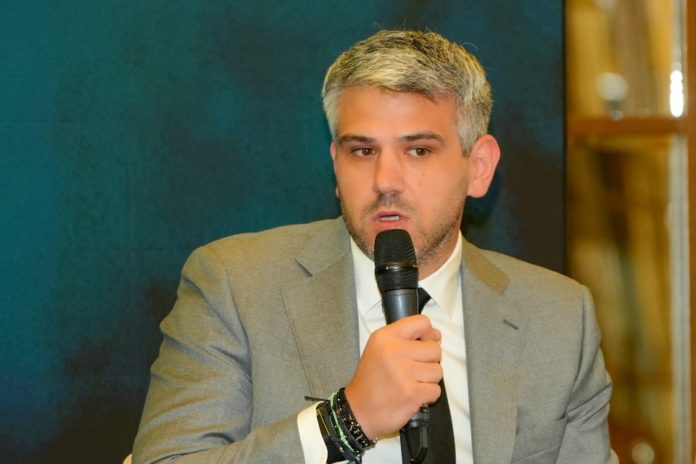
As Romania adds new renewable generation capacity, the next challenge will be how to operate and manage that energy efficiently, particularly as the electricity system becomes more complex, Gabriel Tomescu, CEO of BMF Group, said at the Green Energy Conference, organized by The Diplomat-Bucharest.
“BMF Group currently manages around 15 million square meters of buildings across all active industries in the country, from factories and offices to logistics and oil and gas. We are an energy efficiency, management, operations and maintenance provider for these production and consumption centers, which in recent years have increasingly focused on this renewable energy wave,” Tomescu said.
He said the market is now entering what he considers a natural next stage: moving beyond simply adding generation capacity toward managing that capacity efficiently.
“Now we have reached what we consider to be a natural stage, in which, alongside the development of new production capacities, a new perspective and a new pressure emerge: how we operate and how we manage these production capacities efficiently,” Tomescu said.
He argued that rapidly increasing generation capacity does not automatically translate into an ability to use the additional electricity efficiently.
“If tomorrow we could double our production capacity overnight, I don’t know whether we would be capable of managing this energy efficiently. Most likely, the answer would be no,” he said.
Tomescu said BMF Group’s experience managing a large portfolio of buildings gives it detailed insight into the consumption patterns of its customers.
“We are specialists in this area, but on the other hand, by managing 15 million square meters, we know at every moment the 24-hour consumption curve of each of our partners,” he said.
This data is being used to develop an integrated approach that combines renewable generation, storage and energy efficiency.
Tomescu said the objective is not only to secure cheap and low-carbon electricity, but also to reduce the amount of energy required in the first place.
“Together with our internal divisions, we think about things as an ecosystem. On the one hand, we are interested in having cheap energy and, if possible, having it be 100% renewable, with an almost zero carbon footprint,” he said.
“But on the other hand, we have a perspective on how to obtain the cheapest energy. The cheapest energy is the energy you do not waste, the energy you do not consume unnecessarily,” Tomescu added.
Buildings’ heating, ventilation and air-conditioning systems represent a major opportunity in this area.
“In every building, the largest consumer is the HVAC system. Our objective is to reduce this consumption,” he said.
By combining demand-side efficiency with renewable generation, Tomescu said companies can address two sides of the energy equation simultaneously.
“Already, in this energy equation, we are solving two unknowns. On the one hand, energy consumption, and on the other hand, renewable energy,” he said.
Tomescu said BMF Group has spent the past 10 to 15 years developing expertise in processes, mechanisms and digital monitoring platforms designed to identify and analyze consumption patterns.
“From this ecosystem that we have created over the past 10-15 years, in which we have specialized and developed strong performance in processes, mechanisms and digital monitoring and consumption-curve identification platforms, today we are integrating, alongside photovoltaic systems and batteries, everything that energy efficiency means,” he said.
This includes modern HVAC technologies, heat pumps and geothermal solutions. “We are integrating modern technology solutions for HVAC systems, from the use of heat pumps to geothermal solutions,” Tomescu said.
He said the company’s approach is increasingly focused on integrating multiple technologies rather than treating renewable generation and energy efficiency as separate projects.
“We are among the few integrators, at the 360-degree concept level, with the ability to integrate not only photovoltaic panels and batteries, but also other efficient systems and emerging technologies,” Tomescu said.