
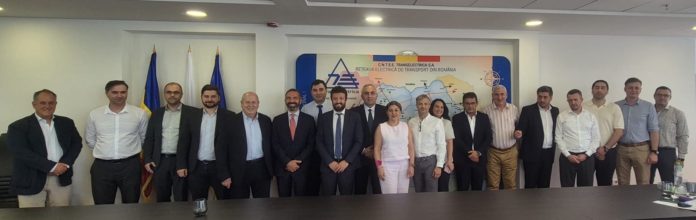
Romania’s electricity transmission system operator, Transelectrica, hosted a technical workshop on July 29, 2026, dedicated to the Georgia–Romania Black Sea Submarine Cable (BSSC), one of the European Union’s strategic energy infrastructure projects in the Black Sea region.
The event brought together representatives of Transelectrica, Georgian State Electrosystem (GSE), Georgia’s transmission system operator, CESI, the Romanian Maritime Hydrographic Directorate, the Romanian Border Police, as well as institutions and technical consultants involved in the development of the project.
The workshop focused on reviewing the project’s progress and coordinating the next implementation stages. Discussions centered on preparations for the Black Sea seabed study (marine survey), the proposed cable route, permitting procedures for the Romanian section, the implementation schedule, and updated cost estimates.
The Black Sea Submarine Cable is a project of strategic importance for regional and European energy security. The close technical cooperation among the project partners represents an important milestone in advancing the project’s maturity and implementation. The workshop reflects the partners’ shared commitment to developing infrastructure that will diversify energy sources, strengthen the resilience of electricity systems, and enhance interconnection between the European Union and the South Caucasus region.
Current activities are focused on preparing the marine survey, which will confirm the optimal route for the submarine cable and provide the technical data required for detailed engineering and infrastructure design. In parallel, work is underway to update the feasibility study and conduct the economic, financial, and regulatory analyses that will support future implementation decisions.
A key topic of the meeting was the Romanian component of the project. Participants reviewed the proposed route, the permitting process, and the technical conditions required to integrate the new interconnection into Romania’s Electricity Transmission Network and National Power System. Discussions also addressed the investments needed to integrate approximately 1,300 MW of new transmission capacity in the Constanța area.
The project is currently receiving World Bank financial support for its preparatory phase and is undergoing assessment within the TYNDP 2026 process following its inclusion on the European Union’s second list of Projects of Common Interest (PCI) and Projects of Mutual Interest (PMI). These milestones are expected to further strengthen the project’s European strategic status and facilitate access to dedicated funding for strategic energy infrastructure.