
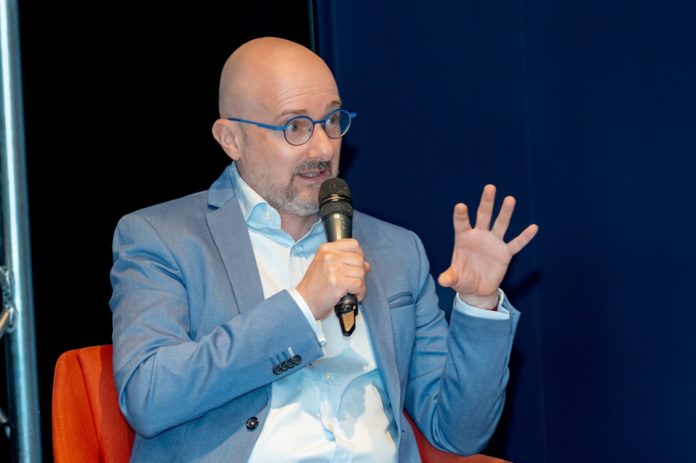
Artificial intelligence, employee experience, and closer collaboration between HR and facility management teams will play a defining role in the future of work, according to Cristian Vasiliu, Managing Director of the Romanian Workplace & Facility Management Association (ROFMA), speaking at the Workplace of the Future conference organized by The Diplomat-Bucharest.
Vasiliu highlighted the rapid advancement of AI technologies and their growing impact on workplace and facility management operations.
“About two months ago, at an international facility management conference, I witnessed something remarkable for the first time: two AI agents negotiating a facility management contract with each other,” Vasiliu said. “It was fantastic. At some point, the organizers stopped the process. Don’t ask me why—you can probably guess.”
He also pointed to emerging business models powered almost entirely by artificial intelligence.
“One of the leading software companies in workplace management, real estate, and facility management has created an investment fund focused on startups,” he explained. “They are looking for the first company that will reach one billion dollars in revenue with only one human employee, the entrepreneur and owner. Everyone else will be AI agents.”
According to Vasiliu, such scenarios may become reality sooner than many expect.
“This company is investing in individuals who, within the next two years, could become billionaires through businesses operated almost entirely by AI agents,” he said.
Beyond technology, Vasiliu argued that workplace management professionals must increasingly adopt principles from the hospitality industry to attract employees back to the office.
“Workplace management means learning a great deal from hospitality,” he said. “Professionals in real estate, workplace management, facility management, and HR must increasingly focus on creating experiences.”
He noted that many young employees entering the workforce today completed much of their education online and have limited experience with physical learning environments.
“We are already hiring graduates who have gone through university without attending a single in-person class,” Vasiliu said. “They learned entirely online and do not know what it means to study in a classroom, within a group, or as part of a collective.”
As hybrid work becomes the norm, organizations need stronger incentives to encourage office attendance, he added.
“If we want people to come to the office two or three days a week, we must offer them experiences, not just services,” Vasiliu said. “The question is: who creates those experiences? HR? Top management? Direct managers? In reality, everyone is involved, but facility management, corporate real estate, HR, and leadership must work together.”
He believes this shift is transforming the role of facility management from a largely invisible operational function into a strategic contributor to employee engagement.
“For many people, facility management used to mean the cleaning contractor, the plumber, or the person changing filters and fixing equipment,” Vasiliu said. “People simply wanted a pleasant working environment with the right temperature, good air quality, proper lighting, and reliable services.”
“Today, things are changing. Facility management must help deliver meaningful experiences, and it can only do so in partnership with HR,” he added.
Looking ahead, Vasiliu suggested that AI could even become part of workplace negotiations between employers and employees.
“Young candidates increasingly come to salary negotiations with information generated by ChatGPT,” he said. “One possible future scenario is that HR responses will also be generated by AI. Then the employee’s AI agent will negotiate directly with the HR department’s AI agent.”
Despite the growing influence of artificial intelligence, Vasiliu emphasized that the office’s future value will increasingly revolve around human interaction and experience.
“The office is becoming a place where people come to feel good and to have meaningful experiences—not necessarily just to work, or not only to work,” he concluded.