
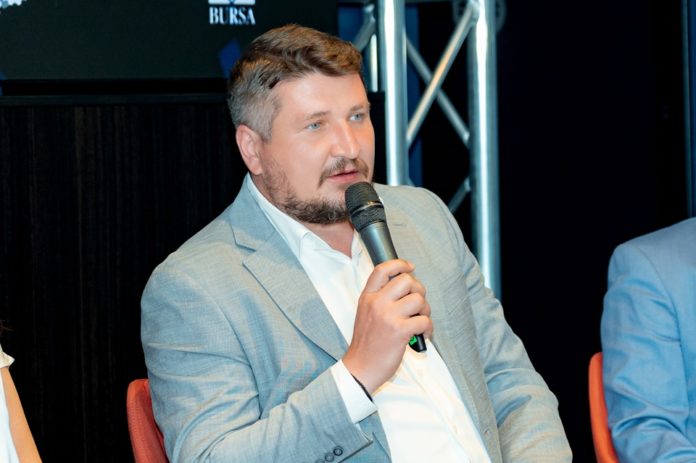
Artificial intelligence has become an unavoidable force reshaping organizations, but companies must remain selective in how they adopt and deploy it, according to Ionuț Petre, Head of Digital Transformation and Governance Department at ICI Bucharest.
Speaking at the Workplace of the Future conference organized by The Diplomat-Bucharest, he described AI as a dominant presence in today’s business environment but warned against indiscriminate implementation driven by industry pressure.
“Artificial intelligence is now the elephant in every room. Not only companies, but every institution is faced with difficult choices. Let’s implement it, but what exactly do we choose?” Ionuț Petre said.
He noted that many organizations are driven by a fear of missing out, leading to rushed or unnecessary deployments.
“That is, I think, the main challenge for companies: what do we actually choose? Because there is also this fear of missing out. All companies around us are doing it, so we feel we must do it too,” he said.
According to Ionuț Petre, AI should not be used universally, but rather in targeted areas where it delivers clear value. “It is not always necessary to use artificial intelligence. I believe we should be selective in where we apply it,” he added.
He emphasized that human capabilities such as empathy, emotional intelligence and critical thinking remain essential differentiators. “We should rely on skills that differentiate us: emotion, empathy, decision-making capacity, conflict resolution and critical thinking,” Ionuț Petre said.
At the same time, he acknowledged the significant opportunities AI creates, particularly for skilled professionals who can effectively guide and validate its outputs. “You have senior engineers who know how to use it and have that critical thinking, the ability to write good prompts, to properly implement systems and to ensure the viability of solutions – to check whether AI has reasoned in the way you expect it to,” he explained.
Ionuț Petre said organizations must also be prepared for rapid technological change, which is accelerating decision-making pressure across industries. “We are at about three and a half years of artificial intelligence. It is everywhere, especially in technical fields. I don’t think there are events anymore where it is not discussed. Companies are adapting on the fly, because what we no longer have is time,” he said.
He highlighted a growing paradox: while AI is meant to improve efficiency, it also increases complexity and pressure inside organizations. “We want to use AI to gain quality time. Paradoxically, the number of tasks increases, pressure increases, and solutions appear overnight,” Ionuț Petre noted.
Frequent model updates and rapid innovation cycles make long-term implementation strategies difficult, he added.
“It is extremely hard to say you have implemented a solution across the entire company, only to discover weeks later that other agents are better. What do you do then? Do you change everything from the ground up?” he said.
Ionuț Petre also warned that this constant change creates financial, organizational and managerial pressure. “This pressure translates across the entire organization – financial pressure, employee pressure, leadership pressure: what decision should we take?” he said.