
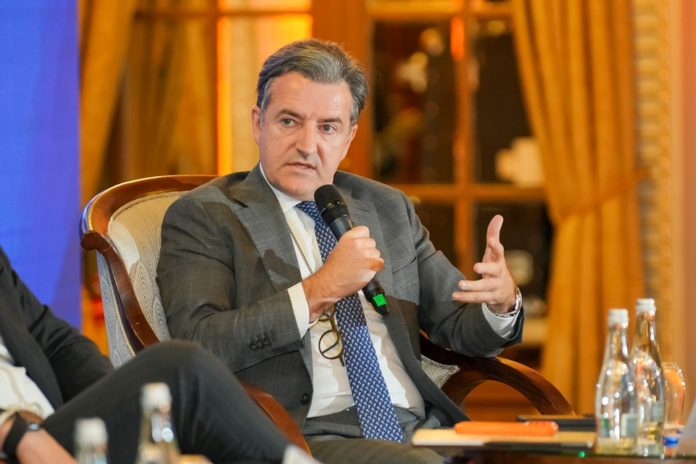
As Romania accelerates investments in renewable energy generation, the next critical step will be electrification and large-scale upgrades to energy networks, according to Corneliu Bodea, CEO of Adrem.
Speaking at the Energy CEO Forum organized by The Diplomat-Bucharest, Bodea said Adrem’s long-term strategy remains firmly anchored in grid infrastructure, an area where the company has built expertise over more than three decades.
“Adrem has a slightly different DNA from many of the companies active in the market today. With more than 33 years of experience, we have gone through multiple economic and industry cycles and have continuously adapted to very different circumstances. For us, adaptation is a never-ending story,” Bodea said.
He noted that Adrem’s roots are deeply connected to electricity and gas networks, from maintenance services and modernization projects to grid automation initiatives.
“We come from the grid business. Whether we are talking about services, network modernization or automation projects, our expertise has always been linked to energy networks. We believe that this will continue to be the foundation of our business in the future,” he said.
While most current investment flows are directed toward renewable generation projects, Adrem is focusing on helping developers connect new assets to the grid.
“Our specialization is delivering grid connection solutions. That is why we are very open to working with partners whose expertise lies in renewable energy generation, conventional power generation, gas or hydropower projects,” Bodea explained.
According to the Adrem CEO, the industry’s attention is currently focused too heavily on generation capacity while overlooking the role of energy demand.
“What we are leaving out of the equation today may be the most important element of the entire energy value chain: consumption,” he said.
Although optimistic about Romania’s long-term prospects, Bodea expressed concerns about whether demand growth will keep pace with the rapid expansion of electricity generation.
“We are finally investing heavily in power generation, something we probably should have done much more consistently over the last 20 years. The question now is who will consume all this energy,” he noted.
Bodea believes electrification will become the next major strategic priority for both Romania and the European Union.
“In my view, the next logical step for Romania and for the European Union will be electrification in all its forms. The most visible example is transportation, but electrification extends far beyond that,” he said.
He argued that increased electricity consumption is essential to support investments in network infrastructure.
“Growing consumption is critical because it allows the fixed costs of the energy system to be spread across larger volumes of electricity. Without higher demand, it becomes increasingly difficult to justify the investments that networks require,” Bodea said.
The CEO expects future electricity demand growth to place particular pressure on low- and medium-voltage networks, areas where significant modernization efforts will be required.
“Additional demand generated by electrification will primarily affect low-voltage and, to some extent, medium-voltage networks. These are often older networks where investments are more difficult to implement and where substantial attention will be needed,” he added.
Looking ahead, Bodea expects the largest wave of infrastructure spending to take place after 2030.
“We are already seeing growing awareness among regulators, policymakers and distribution companies that more investment is needed. European funding is available and will likely continue. I believe that after 2030 the largest volume of investments in the energy sector will be directed toward networks,” he said.
Discussing market conditions, Bodea argued that businesses can no longer rely on the levels of predictability that existed before the pandemic.
“It is obvious that we can no longer talk about predictability. After the pandemic, predictability has become more of a dream than a reality. We live in times when we cannot expect or demand certainty in the way we once did,” he said.
Bodea also challenged some common explanations for Romania’s relatively high electricity prices.
“Electricity prices in Romania are not high because of the European Union, the ETS scheme or the market model. They are high because we failed to invest in power generation for more than two decades. For 20 to 25 years, we made only one major investment in generation capacity, the Brazi power plant, and very little else,” he said.
Despite current challenges, Bodea remains convinced that Europe must continue pursuing its energy transition objectives.
“We must continue the energy transition across all its components. Electrification is absolutely necessary if we want the transition away from fossil fuels to succeed. The European Union has no viable alternative but to rely increasingly on renewable energy resources,” he concluded.