
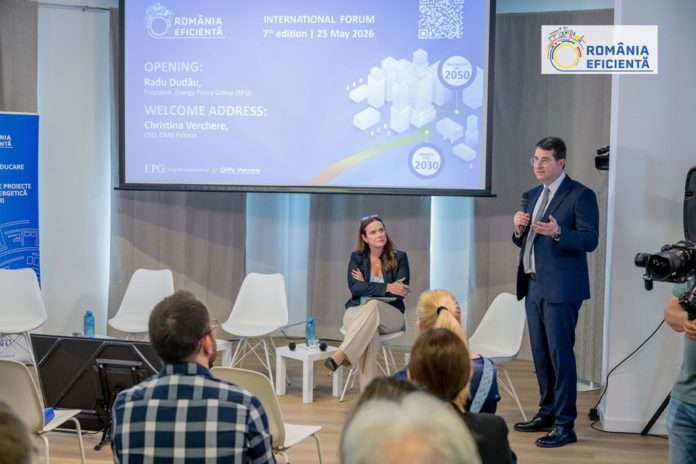
Energy experts, construction industry representatives, policymakers and civil society stakeholders gathered at the Romania Eficientă Forum 2026, organized by the Energy Policy Group (EPG) with the support of OMV Petrom, to discuss building decarbonization, energy efficiency and the role of a just transition in achieving the European Union’s 2030 climate objectives.
Opening the event, Radu Dudău, President of EPG, highlighted the contribution of the Romania Eficientă program to fostering a national culture of energy efficiency through both public awareness campaigns and the renovation of public schools to near-zero energy building (nZEB) standards. He identified three key topics shaping the current policy agenda: Romania’s National Building Renovation Plan (NBRP), sustainability and circularity in the built environment, and the implementation of ETS2, the European Union’s new carbon pricing mechanism for buildings and transport.
Christina Verchere, CEO of OMV Petrom, emphasized the importance of energy efficiency from both a corporate and societal perspective.
“The cleanest and cheapest energy is the energy we do not consume. The greatest opportunity for energy decarbonization lies in how we use energy more efficiently,” Verchere said.
She also pointed to OMV Petrom’s ongoing investments supporting the energy transition, adding: “We contribute to decarbonization by promoting an energy transition that progresses at a realistic pace and through pragmatic solutions.”
The forum also featured an online presentation by Bogdan Atanasiu, policy expert at the European Commission’s Directorate-General for Energy (DG ENER), who outlined the latest developments in the implementation of the Energy Performance of Buildings Directive (EPBD) across EU member states and reviewed Romania’s progress in transposing the directive into national legislation.
Atanasiu stressed that the EPBD’s impact extends well beyond climate targets.
“The EPBD is not only about sustainability, reducing energy consumption or lowering emissions and pollution. It is also about more affordable housing, job creation and economic competitiveness,” he said. “It means better buildings that consume less energy, generate lower utility bills and reduce financial pressure on occupants while increasing resilience to crises similar to those experienced in recent years.”
He added that energy-efficient buildings contribute to supply security, greater energy independence and lower infrastructure investment needs, helping create a more stable and flexible energy system.
The forum’s first panel focused on the development of Romania’s National Building Renovation Plan, bringing together institutional representatives and technical experts from Romania, Bulgaria and Greece. Speakers included Anca Ginavar, Director at Romania’s Ministry of Development, Public Works and Administration, Dragomir Tzanev, Executive Director of the Center for Energy Efficiency EnEffect, and Alice Corovessi, Director of the Institute of Zero Energy Buildings.
Technical perspectives were provided by Cătălin Lungu, President of the Romanian Order of Energy Auditors, and Theodor Bratoșin, Research Associate at EPG, who discussed minimum energy performance standards and local renovation planning developed under the REDESIGN project.
Participants identified several common challenges facing the region’s building stock, including complex regulatory frameworks, aging buildings, the substantial investments required to meet renovation targets, reliance on public funding and insufficient coordination among institutions and local authorities.
At the same time, panelists emphasized that accelerating and improving renovation efforts will require closer cooperation among neighboring countries through knowledge sharing, the exchange of best practices and stronger regional coordination, alongside enhanced collaboration between central and local governments, private-sector actors and building owners.
The second panel addressed circularity and sustainability in the built environment, focusing on the forthcoming requirement to calculate and report a building’s Global Warming Potential (GWP) throughout its lifecycle. Discussions covered the development of national calculation methodologies, reporting obligations to the European Commission, integration of GWP indicators into building permits, the use of low-carbon construction materials and demolition waste management.
Speakers included Raul Pop, State Secretary at the Ministry of Environment, Waters and Forests, Eugen Pănescu, Vice President of the Architects’ Council of Europe (ACE), Mihai Moia, Executive Director of ROENEF, and Andrei Ceclan, President of the Romanian Society of Energy Auditors and Managers (SAMER).
The forum concluded with a panel dedicated to ETS2 and its implications for affordable and energy-efficient housing. Participants examined the impact of the new emissions pricing mechanism on consumers, challenges related to energy poverty and the need for integrated data systems to identify vulnerable households more effectively.
The discussion featured Ruxandra Chirilă, Director at the Ministry of Investments and European Projects, Laura Nazare, Energy Transition Campaign Coordinator at Bankwatch Romania, and Constantin Postoiu, Head of Data Analytics at EPG.
Panelists also explored how the forthcoming Social Climate Fund could help mitigate the social impacts of ETS2 by supporting vulnerable consumers and facilitating investments in energy efficiency measures.
The Romania Eficientă Forum 2026 highlighted the growing importance of coordinated policies, investment and stakeholder cooperation in achieving Europe’s climate goals while ensuring that the transition to a low-carbon economy remains socially equitable and economically sustainable.