
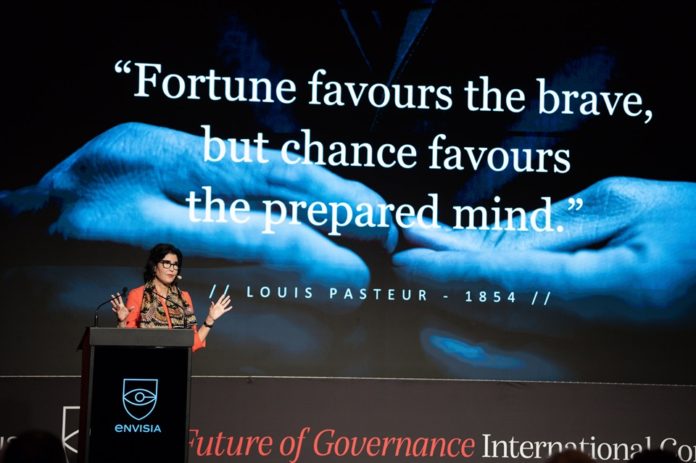
Tina Fordham warns at Future of Governance 2026 that geopolitics is redefining leadership, markets and the global operating system
Articol Opinie Speaker international Envisia Future of Governance Conference
Speaking at the opening of the Future of Governance International Conference 2026 in Bucharest, geopolitical strategist Tina Fordham described today’s global environment not as a period of temporary instability, but as a structural rupture reshaping the foundations of business, governance and international relations.
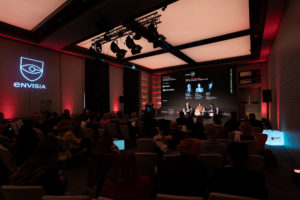
The conference, organized by Envisia – Boards of Elite under the theme The Great Governance Reset, gathered international board members, policymakers, business leaders and governance experts to discuss the growing pressure placed on leadership institutions worldwide.
Fordham, former Chief Global Political Analyst at Citi and advisor to governments, multinational corporations and international organizations, argued that the assumptions underpinning the post-Cold War economic order are progressively collapsing.
“The world many leaders are waiting to return to no longer exists,” she said. “And organizations that continue to operate under those assumptions risk strategic irrelevance.”
Geopolitics Moves to the Center of Corporate Strategy
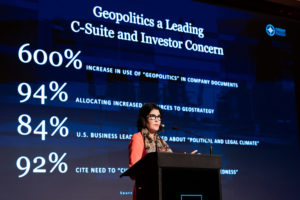
A key theme of Fordham’s keynote was the accelerated integration of geopolitics into core business decision-making.
For decades, geopolitical risk was largely associated with emerging markets or conflict zones. Today, however, developed-market executives are increasingly confronted with instability driven by trade disputes, strategic competition, technological dependencies and institutional fragmentation.
Fordham cited research showing a dramatic increase in geopolitical risk events over the past decade, alongside weakening institutional mechanisms capable of mitigating systemic shocks.
This dynamic forms what she calls the “Geopolitical Supercycle” — an era in which geopolitical tensions become a permanent feature of the global operating environment rather than a temporary disruption.
“Volatility is not interrupting the system. Volatility is the system.”
According to Fordham, this reality is forcing organizations to rethink not only risk management, but also the assumptions behind globalization itself.
 Sovereignty, Autonomy and the New Strategic Logic
Fordham pointed to the growing importance of concepts such as sovereignty, strategic autonomy and resilience in both government policy and corporate strategy.
What initially emerged as efforts to reduce dependency on China has evolved into a broader movement aimed at reducing systemic dependency altogether — including dependence on the United States.
She referenced the European Union’s increasing focus on digital sovereignty, strategic infrastructure and independent technological capabilities as evidence of this shift. “The logic of hyper-globalization is being replaced by the logic of resilience,” Fordham argued. This transition is already visible through shorter and more regionalized supply chains, increased strategic stockpiling, critical infrastructure investment, and a growing emphasis on trusted operational ecosystems.
 Europe’s Window of Opportunity
While much of the keynote focused on rising instability, Fordham also argued that Europe may hold a strategic advantage in the years ahead. In a fragmented world marked by declining trust and systemic uncertainty, institutional stability and predictability may become increasingly valuable geopolitical assets.
“Stability could become Europe’s superpower.”
This message resonated strongly in Bucharest, particularly as Central and Eastern Europe increasingly positions itself within newly emerging trade, security and supply-chain configurations.
 Leadership Beyond the Illusion of Certainty
Fordham concluded by emphasizing that the leadership models of the past are no longer sufficient for navigating today’s geopolitical environment.
She introduced the idea of Political Quotient (PQ) — the capacity of leaders to understand how geopolitics, public sentiment, institutional trust and political legitimacy shape economic outcomes.
She also warned against the tendency of organizations to dismiss “unlikely” scenarios, noting that many geopolitical developments previously considered implausible have materialized with surprising speed over the past decade.
Near the end of her keynote, Fordham referenced a word recently used by Mark Carney at Davos: “Rupture.”
- Not transition.
- Not recalibration.
- Rupture.
“If this is truly a rupture,” she concluded, “then leadership cannot be built around nostalgia for a previous system. It must be built around the capacity to navigate the one now emerging.”
The conference forms part of Envisia – Boards of Elite’s broader governance and board leadership ecosystem, which includes executive education initiatives, international governance partnerships and the Envisia Connect community platform for board members and senior leaders across the region.