
Powering Romania’s Energy Transition | Editorial Series by The Diplomat-Bucharest
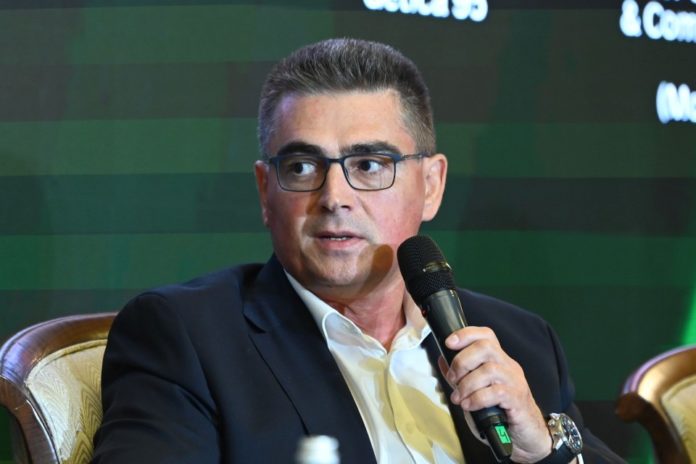
“Romania has chronically underinvested in transmission and distribution infrastructure, and a grid that cannot efficiently absorb, balance, and dispatch renewable generation effectively caps the value of every megawatt installed. The critics here are not only vocal — they are right. (…) The numbers on the ground confirm this: technical grid connection approvals in Romania had been issued for over 80,000 MW by early 2026, against an economy that needs approximately 9,000 MW of new capacity, and less than 10% of those approved projects have progressed into actual investment. That is not a pipeline; it is a queue, and much of it will never move. Industry participants at recent forums have estimated that only around 10% of Romania’s 66 to 70 GW development pipeline will ultimately be realised, and that standalone solar projects without storage integration are increasingly unbankable in the current grid environment,” Christian Leonte, CEO WALDEVAR Holding told The Diplomat-Bucharest.
“I am cautiously optimistic, a realist, and I think Romania’s structural position is stronger than many realise. The country has an excellent diversified generation mix, hydro, nuclear, natural gas from domestic sources, and now a rapidly growing renewable base, that provides genuine resilience against the kind of single-source dependency that made other European countries so vulnerable after 2022.”
How do you evaluate Romania in terms of cost competitiveness versus productivity in the energy sector, amid rising EU carbon pricing?
Romania scores well on cost competitiveness and will score even better as carbon pricing rises, but low productivity is evident and manifesting in the whole economy. Closing this gap is the defining challenge of this decade for our market.
The country holds a rare combination of structural advantages: labour costs that remain genuinely competitive within the EU, a deep and capable engineering talent base, and a solar and wind resource profile that produces some of the lowest levelized cost of energy figures on the continent. The caveat, an extremely important one, is that natural endowments translate into economic advantage only when the surrounding system is built to capture them. We need to get there soonest.
On EU carbon pricing, the picture is deliberately double-edged, and I think it is worth being precise about both edges. The progressive phase-out of free ETS allowances and the full activation of CBAM, which entered its definitive regime on 1 January 2026 at an opening price of €75.36 per tonne of CO₂, will impose raising structural costs on Romania’s carbon-intensive industrial sectors, particularly those that have historically relied on cheap coal and gas generation. That is not a distant risk; it is already showing on balance sheets, and it will accelerate sharply through the decade as free allowances are reduced by nearly half by 2030 and eliminated entirely by 2034.
The argument I find myself returning to in every conversation with international investors is that the very same mechanism that pressures heavy industry is a powerful structural accelerant for renewable investment. Every euro added to the cost of fossil-based generation expands the competitive margin of solar, wind and now energy storage. Romania’s irradiation profile is comparable to northern Spain. Industry voices have made this point compellingly: renewables are today the cheapest form of new generation; this is an undeniable fact. At those economics, the investment case for new renewable capacity is robust across virtually any ETS price scenario.
I urge the most honesty on productivity, specifically grid productivity. Romania has chronically underinvested in transmission and distribution infrastructure, and a grid that cannot efficiently absorb, balance, and dispatch renewable generation effectively caps the value of every megawatt installed. The critics here are not only vocal — they are right. A recent Ember analysis covering 20 EU countries found that Romania is among the markets with the most severe transmission constraints, identifying it explicitly alongside Bulgaria, Poland, and Slovakia as countries already facing capacity gaps that threaten the viability of new renewable connections. The numbers on the ground confirm this: technical grid connection approvals in Romania had been issued for over 80,000 MW by early 2026, against an economy that needs approximately 9,000 MW of new capacity, and less than 10% of those approved projects have progressed into actual investment. That is not a pipeline; it is a queue, and much of it will never move. Industry participants at recent forums have estimated that only around 10% of Romania’s 66 to 70 GW development pipeline will ultimately be realised, and that standalone solar projects without storage integration are increasingly unbankable in the current grid environment.
The regulatory response is arriving, but unevenly. Key impediments identified by legal and regulatory analysts include changes creating investor uncertainty, lengthy and complex permitting processes causing delays and higher costs, and limited grid capacity with unresolved technical challenges. Political and economic uncertainty, including the risk that political changes alter sector priorities and cause delays or inconsistencies in policy implementation, has been flagged as one of the most significant structural risks to Romania’s renewable buildout.
Leading voices in the sector have noted that the energy transition across Europe will require mobilising in the order of five trillion euros over the next decade, and that regulatory uncertainty remains among the most significant barriers to that mobilisation. Romania’s grid modernisation programme, backed by the EU Modernisation Fund, is pointed in the right direction, but pace matters as much as direction. From where WALDEVAR sits, operating both as an turnkey EPC contractor and as an O&M operator across a growing portfolio of assets, we observe directly and daily how grid constraints compress the realised productivity of installed capacity. Solving that bottleneck is not a secondary priority alongside generation investment. It is, in many respects, the primary one.
How could public authorities better support investors in energy projects?
I will be direct, because I think the industry sometimes talks around this issue diplomatically when a more candid conversation would be more useful.
The single most impactful thing Romanian authorities could do is deliver permitting and grid connection processes that are predictable in timeline and outcome. Not necessarily faster, but predictable. An investor can plan around a 24-month permitting process if they know it will actually be 24 months. What kills investment cases is the combination of opaque timelines, inconsistent interpretations of regulations by different local authorities, and grid connection queues that stretch without visibility into sequencing or progress. A coordinated effort between public authorities and the private sector is necessary , and it is worth noting that this kind of collaboration has been absent for 15 to 20 years and has cost Romania dearly. The market knowledge that private operators have accumulated should be systematically channelled into policy design, not locked out of it.
The second area is regulatory consistency. There are concerns about the risks of policy changes in Brussels creating new challenges for RES projects, noting that the utility industry needs certainty to mobilise the scale of capital the transition requires. At the national level, Romania has at times introduced retroactive changes to support mechanisms and grid access rules that eroded investor confidence. The CfD auction mechanism is a step forward, as it provides longer-term revenue visibility, but its implementation needs to be fast, transparent, and frequent enough to match the pipeline of projects that are ready to move.
Third: ANRE and Transelectrica need to mobilize and accelerate the technical studies and grid reinforcement works that are currently the primary bottleneck for project commissioning. The pipeline of shovel-ready projects is enormous. Installed capacity is around 20 GW while the project pipeline approaches 60 GW, that ratio tells you everything about where the constraint lies. It is not capital, it is not technology, it is not execution capacity. It is the system that sits between a completed project and a commissioned, revenue-generating asset.
How confident are you about Romania’s energy security outlook for 2026–2030, given geopolitical disruptions?
I am cautiously optimistic, a realist, and I think Romania’s structural position is stronger than many realise. The country has an excellent diversified generation mix, hydro, nuclear, natural gas from domestic sources, and now a rapidly growing renewable base, that provides genuine resilience against the kind of single-source dependency that made other European countries so vulnerable after 2022.
The recent lesson for Europe is that energy security and economic security are inseparable. Romania absorbed that lesson earlier than most, partly because its geography and its historical experience with Russian energy politics gave it a different perspective. The Neptun Deep gas project, expected to bring significant volumes to market from 2026, adds another layer of domestic supply security and positions Romania as a potential net exporter of gas to the region.
From Suez in 1956 to the Middle East crises of the 1970s, to Russia’s 2022 invasion, to today’s tensions around the Strait of Hormuz — every geopolitical disruption to fossil fuel markets has translated directly into higher energy prices in Europe. The structural answer is the same each time: reduce exposure to fossil fuel markets, now through domestic renewable generation. By 2030, with solar capacity potentially reaching 24 GW and wind continuing to grow, Romania’s exposure to those external shocks will be sensibly lower than it is today.
The risk I would flag is not the generation side; it is grid resilience and storage. Romanian energy leaders have now formally identified energy storage as an action priority, with commitments to deploy 1.2 GW of battery storage and 0.8 GW of pumped hydro by 2030. WALDEVAR is directly involved in executing that storage agenda. We also find ourselves at the forefront of the industry innovations and evolution by realizing Floating PV Plants, one huge untapped resource in Romania and the whole Europe. A system with high renewable penetration but insufficient storage and grid flexibility remains vulnerable to different kinds of instability, price volatility, frequency management challenges, and curtailment losses. Solving that is the work of this decade, and it’s a conjugated work of many stakeholders.
Where do you see the biggest growth opportunities in Romania’s energy mix during this period?
Three areas stand out clearly, and we are actively positioning WALDEVAR across all three.
The first is utility-scale solar hybridized with battery storage. Romania added 2.5 GW of new solar capacity in 2025 alone, and the medium scenario from Solar Power Europe points to 24 GW total by 2030. That is roughly three times today’s installed base, implying an annual installation rate that needs to be sustained and, in some years, exceeded. The economics are compelling, the CfD mechanism provides revenue visibility, and the EU Modernisation Fund is channelling capital into supporting infrastructure. WALDEVAR’s position as the largest self-performing EPC contractor in Romania makes this our core growth engine.
The second is floating photovoltaics. We have invested €10 million in the only FPV manufacturing facility in Europe, in partnership with Sungrow FPV. The signed contract with Hidroelectrica for the largest FPV installation on a hydroelectric dam in Europe is a proof-of-concept that opens an entirely new category of developable surface, Romania’s water bodies, reservoirs, and dam lakes — without competing with agriculture or other land uses. I expect this market to follow the same exponential trajectory we have seen in Asia, and Romania has the asset base to become a European hub for it.
The third is BESS and grid services. Every new renewable project increasingly needs an integrated storage and SCADA layer to be competitive. WALDEVAR’s in-house Automation and High-Voltage division is designed precisely to deliver that integration, and demand from funds and developers for this capability is growing rapidly.
What investment priorities will define WALDEVAR’s roadmap in Romania’s energy sector over the next 3–5 years?
The first goal is reaching and sustaining 3 GW of installed and under-construction capacity as a baseline, not a ceiling. We have stated this publicly and we are executing it. The pipeline of contracted and advanced-stage projects across Romania, Italy, and France gives us confidence in the trajectory.
The second is deepening our BESS and hybrid project capability. Every new utility-scale park we design from this point forward incorporates storage integration as a standard engineering parameter. The final consumer must be the primary beneficiary of the energy transition, and if there is no coherent shared vision and roadmap, the whole effort risks failure. We share that view entirely. BESS-integrated parks that can participate in grid-balancing markets are the projects that deliver long-term value to both investors and the grid, and they are the projects WALDEVAR is building.
The third is scaling our floating PV factory and commercial pipeline. The Hidroelectrica contract is the flagship reference, but we have projects advancing in France and are evaluating further markets. The Floating Systems factory in Tunari gives us a supply chain advantage that no other European EPC contractor can replicate.
The fourth axis is our O&M and SCADA-EMS digital platform. The 25+ year lifecycle of an energy asset is where the real value is generated, not just in construction. We are investing in proprietary monitoring, predictive maintenance assisted by AI , and dispatch optimization tools that will allow us to manage a growing portfolio of assets we have built, delivering transparent performance data to our institutional clients and maintaining the asset quality that their ESG frameworks demand. The traditional concept of consumption is being replaced by demand, demand being consumption minus self-production,and that this shift is reshaping the entire architecture of the power system. Our SCADA-EMS investment is our answer to that shift at the asset management level.
What were WALDEVAR’s most significant completed projects during 2024–2026?
Several milestones define this period for us. The crossing of 1 GW of total installed and commissioned capacity by the end of 2024 was a landmark, achieved in under a decade from our founding, making WALDEVAR the fastest-growing EPC contractor in Romania’s renewable energy sector.\
In 2025 we crossed into simultaneous construction of over 800 MW across multiple European markets, Romania, Italy, and France while executing completed deliveries to clients, including major investment funds and IPPs operating in the Romanian market.
The Niculești contract for a 200+ MWp photovoltaic park remains the largest single contract in our portfolio and a statement of the calibre of client that now seeks WALDEVAR as their first-choice EPC partner in Romania.
The Hidroelectrica floating PV contract, the largest FPV installation on a hydroelectric dam in Europe, is our most strategically significant reference, because it opens an entirely new asset category and validates our manufacturing investment in Tunari.
And our entry into the Italian market with the six-park Calabria cluster, and soon to be followed by larger ones, followed by further project development in France, demonstrates that the WALDEVAR model based on owned resources, integrated capabilities and single point of accountability is a winning one. The platform we built in Romania is now the foundation for a genuinely worldwide EPC and O&M business.
WALDEVAR’s most successful project, by far is the creation of a highly professional and efficient team that makes the projects in the pipeline to be delivered at the highest quality, on time and under the budget.