
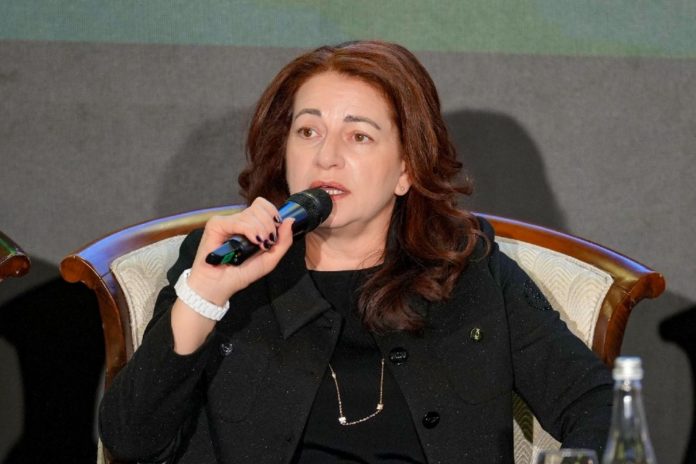
“It has never been easy in public administration to ensure, first of all, that the legislation you draft is as clear as possible, that it is as predictable as possible, and that changes do not appear overnight,” said Mihaela Frăsineanu, State Counselor, Chancellery of the Prime Minister during the Circular Economy Conference organized by The Diplomat-Bucharest. “What is simple, however, is to talk to people. And I believe that is the most important step that needs to be taken, after first thoroughly reading the European regulations.”
Frăsineanu said the shift from directives to regulations is a positive development.
“I think it is very good that we are moving from directives to regulations. Because this means a uniform application of waste management rules, regardless of the waste stream we are talking about, across the territory of the European Union,” she said.
“And this is what we all want, because we do not want another country to which we export waste, or from which we import waste for recycling, to have different legislation or different rules. Nor do we want these rules to become an obstacle to economic activity,” she added.
Key statements:
- “I would like to say that, beyond what comes into force, for example in August — namely the regulation, and we are not talking only about the packaging regulation, but also, for example, waste shipments — we also have legislation that remains constant. Namely, the strategies and plans we have developed over the past few years. It is true that everyone is tired of the PNRR, of milestones and targets and so on, but this has ensured our access to funding sources that we otherwise would not have obtained,” said Mihaela Frăsineanu, State Counselor, Chancellery of the Prime Minister.
- “In Romania’s strategy and action plan for the circular economy, the identification of the ten strategic and priority sectors for which legislation, measures and actions are proposed — together with concrete sub-actions, very clear deadlines, the responsible institutions, authorities or economic operators, and the identification of financing sources — I consider these to be two extremely important documents that we should adhere to,” she said.
- “Because if every time we come back and change the existing legislation or plans after one year, two years or five years, we no longer have predictability. Beyond what is new in European legislation, what is included in the circular economy action plan remains highly valid and also covers the new legislative measures,” Frăsineanu said.
- “I believe we are now at the stage where we are trying to establish the competent authorities, and the most intense discussions are precisely about those competent authorities that must carry out registration, control and monitoring,” she stated.
- “The second very important direction is digitalization, because this ensures the traceability that we all need, especially the authorities, but also economic operators, because they want to prove beyond any doubt that what is happening is indeed correct,” she said.
- “Beyond this traceability, we also need to connect the systems currently in place to European systems, which in turn must be linked to the future platform that the European Commission will provide for registering waste transport and waste transfers. I believe this must happen by the end of the year. The European Commission itself has not met its deadlines by May and we will not yet have the platform available, but this gives us time in which we must do our homework,” Frăsineanu added.
- “Dialogue and understanding the position of the discussion partner must be paramount. Above all, we must be very open and very sincere with one another, to state clearly what the limits are — both for authorities and for economic operators — and to try to avoid overburdening businesses,” she said.
- “There is only one direction: increasing the recycling rate for each waste stream, each type of packaging, and not only packaging,”