
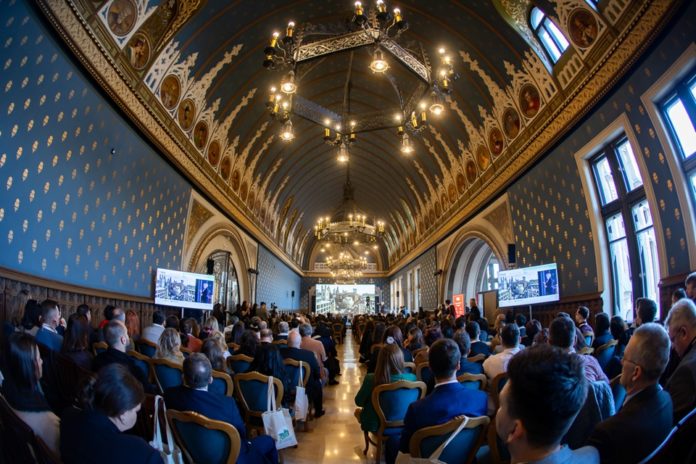
The first edition of TILIA – Today’s Ideas and Leadership in Action (Romanian Cities Summit), organized by the IULIUS Foundation, in partnership with the European Bank for Reconstruction and Development (EBRD), on April 23 and 24, at the Palace of Culture in Iași, gathered 600 in-person participants and over 300 online, in a format that connected local and central administration, architects, urban planners, international financing experts, the business community, academia, and civil society.
How can Romania’s cities grow without losing their people, memory, and energy? How can they become greener, better connected, more welcoming, while also becoming more capable of attracting investment, talent, and infrastructure projects? These were some of the questions that opened the two-day debate proposed by TILIA and brought together perspectives that often remain separate in public discourse.
The TILIA Summit approached urban development from two complementary perspectives. While the first day was dedicated to vision, urban design, architecture, mobility, and wellbeing in cities, the second day focused on concrete solutions, infrastructure, financing, European funds, and public-private partnership mechanisms.
Happy cities are built through trust, nature, and smart mobility
The summit’s special guest, Charles Montgomery, author of Happy City and one of the most influential urbanists internationally, spoke about the direct link between urban design, social trust, and people’s wellbeing. In his presentation, entitled The Science of Happy Cities and Human Wellbeing, Charles Montgomery showed that “urban design dictates behavior, and the cities we build today can bring us together or, on the contrary, isolate us,” and that “when we put cars at the center of the city, we lose space, freedom, and ultimately happiness.” The urbanist cited the transformation of Times Square in New York, the removal of cars around schools in Paris, and the concept of parking-free neighborhoods as models through which technology and alternative mobility can reclaim urban space for people.
A complementary perspective was offered by the team of Foster + Partners, one of the most influential voices in world architecture, which delivered a masterclass at TILIA on global benchmarks for responsible urban design. Stefan Behling, Senior Executive Partner at Foster + Partners, recognized for landmark projects such as Apple Park, the German Parliament headquarters, and Kuwait International Airport, spoke about the need to reconnect cities with nature and with people’s real-life experiences.
“Architecture is not just about buildings, but experiences: we must give cities back to people and create spaces they can truly enjoy. You need to create experiences so people can enjoy urban spaces. We seek to create healthier places for people and help nature return to cities.”
During the summit, Foster + Partners also presented a series of strategic ideas for the remodeling project of Palas Iași, focusing on respecting the site’s historical heritage, creating pedestrian spaces, adding more nature, and improving the connection between the complex and the Palace of Culture.
Raluca Munteanu, Development Director at IULIUS, presented the company’s projects and the vision behind them: that major urban transformations begin with courage, trust, and the ability to see potential where others see only limitations.
“At IULIUS, we care about building for generations, not for quick returns. We have heard countless times that it cannot be done: that an industrial platform cannot be relocated, decontaminated, bioremediated, or reconnected to the city. But our experience shows that some projects seem impossible only until they become reality. The greatest challenge is neither money nor permits, but conviction — of the administration, citizens, and the team — that a place can become more than it is today. Whether we speak about Palas Iași, RIVUS in Cluj, or the project in Constanța, the stake is to have the courage to see potential where others see only risk, and to give the city back spaces that can generate development, trust, and a real multiplying effect for the entire community,” said Raluca Munteanu.
European funds, infrastructure, and public-private partnerships essential for transforming cities
The second day of the summit was dedicated to practical solutions and concrete mechanisms for the development of Romania’s cities. Discussions focused on the relationship between administration and financing, as well as the role of European funds and public-private partnerships.
At the opening of the second day, Mihai Jurca, Head of the Prime Minister’s Chancellery, spoke about the need for partnerships capable of enduring in a volatile climate and about the role of the private sector in long-term infrastructure development. He explained that beyond legislation, the key to successful public-private partnerships lies in understanding the basic principles, especially the sharing of responsibilities and risks between the state and the private sector.
In the panel “Green Cities,” mayors and representatives of local administrations – Lucian Viziteu, Mayor of Bacău; Lucian Pătrașcu, Deputy Mayor of Brașov; Ciprian Ciucu, General Mayor of Bucharest; Constantin Toma, Mayor of Buzău; Vergil Chițac, Mayor of Constanța; Mihai Chirica, Mayor of Iași; Dragoș Chitic, Public Administrator of Piatra Neamț City Hall; Dan Cușnir, Deputy Mayor of Suceava; Bogdan Buhăianu, Deputy Mayor of Botoșani – outlined a common reality of urban development in Romania: cities evolve more through opportunities and constraints than through detailed planning.
In a panel dedicated to financing solutions for public-private partnerships, Marius Perșenea, Chief Operating Officer of IULIUS, emphasized the need for real integration between private urban regeneration projects and infrastructure planned by public administration.
“For nearly 30 years, we built cities separately: administration and investors. The IULIUS Group entered public-private partnerships in Iași and Cluj. Today we are convinced that urban regeneration projects must be fully integrated into infrastructure planned by the administration in order to remain relevant in the long term.”
Sebastian Costea, Manager at IULIUS, showed that predictability is essential for urban regeneration projects.
“A private investor’s wish list starts with predictability. The private partner never has revenues from the second day of the partnership. A grace period is needed, a differentiated payment mechanism, perhaps starting from the moment revenues are generated. A mechanism is needed for mixed-use projects, located at the intersection between concession and public services. There are European jurisdictions that recognize these models and succeed in bringing public and private resources together into a single financing structure.”
Maria Tzanidaki, Principal Manager, PPP Advisory Unit, EBRD, explained that a public-private partnership is a complex mechanism dependent on political commitment and a procedure through which the involved parties develop an implementation model. The optimal model, she said, is a mixed one, where direction comes from the center, but the real impact is local. She also stated that the EBRD is preparing a portfolio of approximately 15 projects, with a total estimated value of around €3 billion, including major economic regeneration projects and advisory services for governments.
Also during the PPP panel, Marcelo Catellanos, Senior Country Manager for Southeastern Europe, International Finance Corporation, added: “The key message is that these models work in many parts of the world. It is important to identify the countries where they work consistently and are maintained in the long term. Examples are the United Kingdom, France, and the Netherlands. In the UK they used this model in transport, education, healthcare, and infrastructure. In France, in railways, energy, and services. In the Netherlands, we have cooperation for airports. When we speak about these countries, we speak about political vision and capacity for collaboration, a culture of cooperation, proper structuring, and finally financiers who understand the context. Romania is ready for PPPs and we believe there are legal provisions that can be improved, but the current framework is good enough to allow PPPs. What is missing is a collaborative structure that distributes responsibilities and risks.”
At the summit, Veolia Romania presented the PPP excellence model between Apa Nova Bucharest, a Veolia company, and the Bucharest City Hall, one of the longest-running and most successful public-private partnerships in the utilities sector in Europe. Signed in 2000, this concession project radically transformed the capital’s water and sewage infrastructure through investments of over €795 million in network modernization, service expansion, and implementation of the highest European quality standards.
Concrete results include: increasing water network efficiency from 50% in 2000 to approximately 80% today — in line with other European capitals; expanding service coverage to over 2.1 million inhabitants; modernization of treatment plants; and transforming the Glina wastewater treatment plant into the largest producer of green energy in the Bucharest metropolitan area.
At the same time, on the second stage, Cities in the Making: Design, Nature and Culture explored the forces shaping a city’s character, with concrete case studies from architecture, creative industries, mental health, and green infrastructure.
From its very first edition, the TILIA Summit outlined the direction that the cities of the future cannot be built in fragments, but through collaboration, vision, integrated solutions, and financing mechanisms adapted to urban complexity. Romania’s cities need public spaces that bring people together, nature, smart mobility, and quality architecture, but also capable administrations, clear rules, predictable financing, and partnerships between the public and private sectors.