
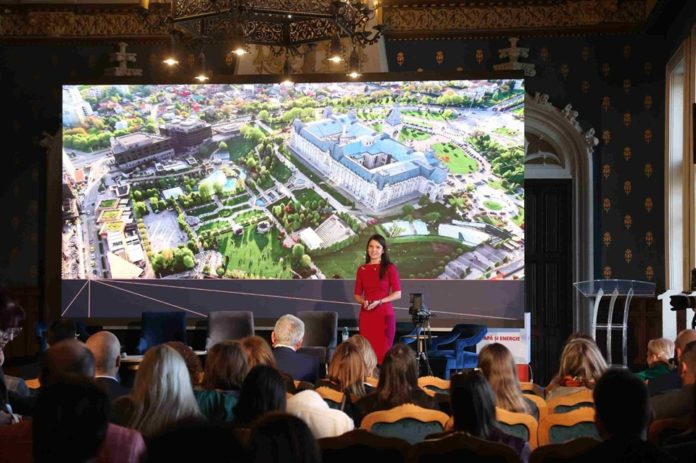
Iași is hosting one of Romania’s most substantial conversations about the future of urban development on April 23–24, 2026, during the TILIA – Summit of Romanian Cities. Organized by IULIUS through the IULIUS Foundation, in partnership with the European Bank for Reconstruction and Development (EBRD), the event brings together more than 400 leaders from public administration, architecture, urban planning, business, international finance and civil society at the Palace of Culture.
The summit focuses on practical dialogue about how cities can be developed in a more coherent, sustainable and people-centered way.
With an agenda centered on vision and urban design, the first day highlighted essential themes for urban transformation: international benchmarks in sustainable design, the role of landscape and green infrastructure in tomorrow’s cities, urban mobility, climate adaptation, and above all, how the quality of urban space directly shapes community wellbeing.
A special guest of the TILIA Summit, Charles Montgomery, author of Happy City and recognized among the world’s 100 most influential urban thinkers, shared his perspective in a keynote titled “The Science of Happy Cities and Human Wellbeing.”
“We already have enough evidence that urban happiness depends not only on infrastructure or economic prosperity, but on the quality of relationships between people. Social connection — with family, neighbors and community — is the key ingredient of a healthy city. Experiments and interventions around the world show that when we design spaces that bring people together, social trust grows, and with it come safety, equity and quality of life,” he said.
Montgomery cited examples from Vancouver, where housing designed around shared spaces fostered real connections between neighbors, and urban regeneration projects where nature and public space changed how people relate to one another.
“Urban design shapes behavior, and the cities we build today can either bring us closer together or isolate us. When we put cars at the center of the city, we lose space, freedom and ultimately happiness. When we put people first, cities become more breathable, safer, friendlier and more vibrant,” he added.
He pointed to the pedestrian transformation of Times Square in New York, car-free school zones in Paris, and the concept of parking-free neighborhoods enabled by new mobility solutions as clear examples of reclaiming cities for people.
The team from Foster + Partners, one of the most influential names in global architecture, delivered a masterclass on international benchmarks for responsible urban design.
Stefan Behling, Senior Executive Partner, known for landmark projects such as Apple Park, the German Parliament headquarters, and Kuwait International Airport, said:
- “When we look at office buildings, we must ask whether they are good or bad for people’s lives. Some projects are completely isolated buildings, like submarines. Is that really our dream? People want to reconnect with nature.”
- “The technological revolution makes us question what cities will look like. Will robots coexist with people? Could they one day take the same buses?”
- “Architecture is not only about buildings, but experiences. We must give cities back to people and create spaces they can truly enjoy.”
- “We aim to create healthier places for people and help nature return to cities.”
Maximilian Zielinski, Senior Partner, outlined the strategic vision behind the planned remodelling of Palas Iași, designed by Foster + Partners:
- “We began by understanding the place and its heritage. Iași is rich in history, and we must respect that while building for the future.”
- “We are focusing our energy on common social spaces where people can meet.”
- “We will create more pedestrian zones that are more human and greener.”
- “The biggest intervention will be the Palas façade, which will open toward the Palace through new inner and outer plazas where people can circulate freely.”
Another major topic was the future of architecture in the age of Artificial Intelligence.
Behling noted that AI is already being used for renderings and generating design options, but cannot yet reliably choose the best solution among hundreds of possibilities.
Susanne Danz, Partner at Foster + Partners, said the profession has adapted before: “Twenty-five years ago everything was drawn by hand. Then we moved to computers and 3D models. This is not the first transformation of our field.”
Raluca Munteanu, Development Director at IULIUS, presented the company’s vision that major urban transformations begin with courage, trust and the ability to see potential where others only see limits. She emphasized the role of urban ecosystems in attracting talent, capital and innovation, as well as reclaiming abandoned or contaminated land for communities.
“We launched TILIA from a simple idea: to bring together everyone who shapes, governs, plans and changes cities through public, private or civic initiatives. Romanian cities can have quality architecture, become friendlier, more coherent and better connected to people’s needs,” she said.
She added: “At IULIUS, we believe in building for generations, not for quick returns. Many times we were told something could not be done — that industrial platforms could not be relocated, decontaminated or reconnected to the city. But some projects only seem impossible until they become reality.”
The first day of debates made one message clear: the cities of the future cannot be built in fragments, but through collaboration, vision and integrated solutions that place people at the center of development.