
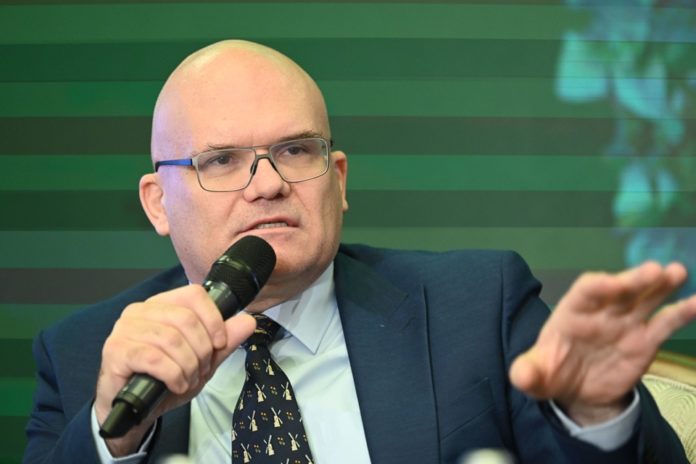
Romania has seen a clear migration from plastic to cardboard packaging over the last 5-10 years, particularly in certain types of packaging, aligning with European regulators’ goals to discourage plastic and promote renewable alternatives, according to Raul Pop, State Secretary at the Ministry of Environment.
Speaking at an event organized by ROMPAP (Paper and Cellulose Industry Employers’ Association) and CERC (Circular Economy Coalition), Pop highlighted the rapid evolution of waste management policies: “We clearly see, at least in the last 5-10 years, a migration from plastic to cardboard, especially in certain types of packaging. This is what the European regulator wanted, ultimately to discourage plastic and encourage packaging or alternatives—not just for packaging—renewable alternatives. At the same time, however, things are evolving so rapidly that we identify all sorts of cracks in the system on the fly, abuses of the system, uninspired decisions that then need to be reconsidered, and so on.”
He emphasized the distinction between packaging and other paper waste, praising the relatively well-structured policy for packaging—despite delays—but pointing to logistical hurdles.
“I would refer here mainly to the distinction between packaging and other types of paper waste. For packaging, we have had a relatively well-thought-out policy for some good years, strategically aligned with European principles—with the usual delay, as I said.” He explained that national logistics systems take years to develop, particularly without aligned stakeholders, citing the deposit-return system as a rare success hard to scale quickly.
Turning to waste paper, Raul Pop reminisced about its state-run past and sporadic current collection, advocating for more systematic school involvement: “I am, rather, in favor of more systematic school involvement in managing certain types of waste. Paper is one of them, but it could also do this for portable batteries, following models that work in other countries.”
Predicting growth, he noted that voluntary collection centers will significantly boost waste paper volumes in the next 4-5 years.
“The steps we are taking now, such as voluntary personal contribution collection centers, I believe will have a significant impact on the quantities of raw material-type waste paper entering the system in the next four-five years,” explained Raul Pop.