
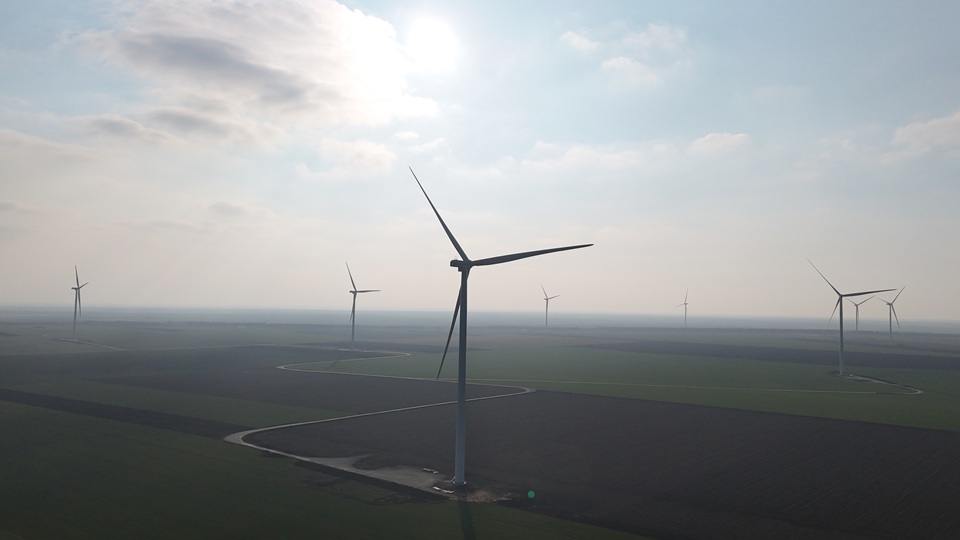
Eurowind Energy Romania announces the start of the testing phase for the Pecineaga wind park, located in Constanța County, as part of the project’s preparation for operationalization. Following the successful energization of the electrical substation and wind turbines, the project has entered a new technical phase, essential for validating the operation of the installations and advancing towards commercial operation.
This stage confirms that the park’s main installations are ready for the final technical checks prior to commissioning. In the coming period, the proper functioning of the equipment, operational safety, and the full integration of the park’s systems will be validated, as the final step before the project enters operation.
With an installed capacity of 48 MW and an investment of approximately EUR 90 million, Pecineaga is one of the key projects in Eurowind Energy’s local portfolio and marks the approach of the moment when this investment will begin to effectively deliver renewable energy into Romania’s National Energy System.
Adrian Dobre, Country Manager Romania, Eurowind Energy, said: “Pecineaga has entered a decisive stage, one in which an investment of approximately EUR 90 million moves from the execution phase to operational readiness. We have reached this point later than we would have wanted, but what matters is that the project has now entered the final testing phase, and we are optimistic that from this point forward things will move at a good pace and that, soon, the park will begin delivering renewable energy into Romania’s National Energy System.”
The Pecineaga wind park is equipped with 8 Siemens Gamesa SG 6.6-170 turbines, the largest wind turbine model installed in Romania. With a rotor diameter of 170 meters and a nominal capacity of 6.6 MW per turbine, this model represents state-of-the-art technology optimized for high efficiency, including in low-wind conditions. At the same time, the turbines installed at Pecineaga stand out through their dimensions: 135-meter towers, 85-meter blades, and a maximum height of 220 meters, making the project a benchmark for the wind technology currently deployed on the local market.
In the coming period, the process will continue with the commissioning of the turbines by the equipment supplier, followed by the specific technical tests that represent the final stage before handover to the beneficiary. Afterwards, the entire wind park will also undergo performance tests to verify compliance, carried out together with the Transmission and System Operator.
Once completed, the Pecineaga wind park is expected to generate approximately 176,000 MWh annually, equivalent to the electricity consumption of around 48,000 households. The project will therefore contribute to increasing local renewable energy production and integrating a new clean generation capacity into the national energy mix.