
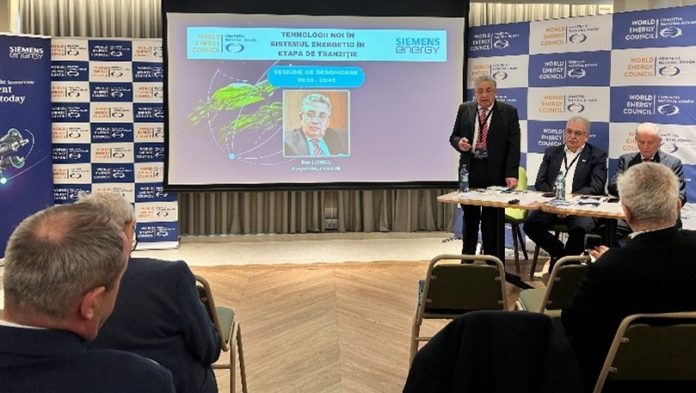
The conference “NEW TECHNOLOGIES IN THE ENERGY SYSTEM IN THE TRANSITION STAGE” was organized on March 13, 2026 by the Romanian National Committee of the World Energy Council (CNR-CME), in partnership with Siemens Energy Romania and took place at Hotel Sinaia.
The event was opened by Prof. Dr. Eng. Ion LUNGU, President of CNR-CME, who emphasized the role of collaboration between industry, authorities and academia in accelerating the energy transition and increasing the resilience of the energy system. “The transformation of the energy system involves the integration of advanced technologies, capable of ensuring flexibility, efficiency and operational safety, in a context marked by the increase in the share of renewable sources and the accelerated electrification of the economy,” he emphasized in the opening of the conference.

The main debate session was moderated by Prof. Dr. Eng. Ștefan GHEORGHE, Executive Director General of CNR-CME, and Dr. Eng. Petru RUȘEȚ, Managing Director at Siemens Energy Romania, and brought to the forefront essential themes for the future of the energy system. Among the topics addressed during the discussions were: the future of electricity networks and the modernization of energy infrastructure; efficient integration of renewable sources in distribution networks; FACTS devices; the role of energy storage systems in reducing production variability; increasing the flexibility of the electric power system; the use of digital technologies and artificial intelligence to optimize the operation of the energy system and solutions to maintain the adequacy of the system in the context of increasing demand for electricity, generated including by the development of data centers and the electrification of the economy.
During the conference, presentations were given by specialists from industry and academia, including representatives of Siemens Energy: Karols PAVELS and Octavian POPESCU; of the Technical University of Cluj-Napoca: Dan MICU together with Tudor CIOARA, and of companies active in the energy sector: Valeriu BINIG and Andrei COTEANU. They analyzed the technological directions that can contribute to increasing the performance, reliability and observability of modern energy systems. Solutions for the evaluation and management of electrical inertia in modern systems were discussed, in the context of the increasing share of renewable sources. The participants highlighted the need to implement advanced technologies for controlling the operation of electrical networks, improving energy quality and efficiently exploiting local energy resources. Specialists in the field presented the latest technological solutions aimed at supporting the transition to a modern, flexible and sustainable energy system.
Among the main topics addressed were the implementation of FACTS (Flexible AC Transmission Systems) solutions, considered essential for increasing the stability and flexibility of electrical networks. The specialists highlighted the efficiency of SVC Plus equipment in grid forming mode, capable of contributing to limiting frequency variations (RoCoF), generating artificial inertia and reducing inter-zonal subsynchronous oscillations. The crucial role of FACTS systems in “weak” electrical networks was also highlighted, where they allow for more efficient control of system events, ensure improved behavior in the event of voltage drops and facilitate rapid restoration after major incidents, including blackouts. The presentations also analyzed SVC Plus FS equipment, equipped with supercapacitors, which can provide artificial inertia similar to synchronous machines, as well as solutions for controlling power flows. These allow for optimizing the loading of electrical lines and maintaining safe operation even in emergency situations.
For the Romanian energy system, concrete opportunities for implementing FACTS technologies in important substations, such as Sibiu Sud, Bradu, Roșiori, Suceava and Gutinaș, were identified. The studies carried out indicate significant benefits from both a technical and economic point of view. At the same time, the development of a modern ±150 MVAr installation at Mostiștea, in the concept of a digital substation, was proposed.
A major topic discussed was the need to gradually eliminate sulfur hexafluoride (SF6), currently used as an insulating medium in high-voltage equipment, but considered harmful to the environment. In this context, current research focuses on the use of clean air as a sustainable alternative, and solutions are already implemented in practice. According to European regulations, the use of SF6 will be prohibited from 2032. Participants also highlighted the challenges generated by the integration of renewable sources, characterized by variability and unpredictability, as well as the emergence of consumers with dynamic load profiles. To meet these challenges, integrated solutions are needed that include the decentralization of production, the development of Demand Response mechanisms, the use of energy storage systems and the implementation of “grid forming” technologies.
Another essential aspect highlighted was the need to strengthen the collaboration between the transmission and system operator and the distribution operators, in order to ensure a permanent balance between production and consumption. In this sense, there is a trend towards expanding the responsibilities of distribution operators in managing the energy system. At the same time, the integration of prosumers into the system requires the development of secure communication infrastructures with distribution operators.
A promising element is the development of a flexibility market, based on the assessment and valorization of the system’s capacity to respond quickly to production and consumption variations. In this context, establishing the necessary flexibility at the system level becomes a strategic priority. The increasingly important role of energy storage systems, especially batteries, in ensuring frequency stability was also highlighted. Given the reduction of the natural inertia of the system, these solutions become essential for rapid reaction to disturbances. The conference also highlighted the contribution of academia in supporting the energy transition, through applied research, the development of innovative solutions and the training of specialists. Areas such as energy efficiency, smart buildings, energy auditing and the use of artificial intelligence in energy data management were highlighted as priorities. Through the solutions presented, the conference highlighted the fact that the energy transition is a complex but achievable process, based on technological innovation, institutional collaboration and long-term strategic investments.
In conclusion, Prof. Dr. Eng. Ștefan GHEORGHE, highlighted the key aspects highlighted in the debates between speakers and participants: the transformation of the energy system requires close collaboration between industry, authorities and academia to ensure flexibility, efficiency and safety; the increase in the share of renewable sources and the electrification of the economy require the adaptation of infrastructure and the modernization of networks; it is necessary to establish a clear legislative framework for electricity distribution operators at the national level; the transition from the concept of adequacy to that of flexibility is critical for the stability and efficiency of networks; the future of the energy system depends on the integration of state-of-the-art technologies, network flexibility, digitalization and collaboration between industry, research and authorities, with the ultimate goal of increasing efficiency, resilience and sustainability in the energy transition stage. The conference also provided a framework for dialogue between industry, research and system operators, contributing to the identification of concrete directions for the modernization of energy infrastructure and the acceleration of the transition towards a sustainable, flexible and digitalized energy system. The event is part of the series of CNR-CME initiatives dedicated to promoting cooperation between relevant actors in the energy sector and disseminating the latest technological solutions for the transformation of the energy system.