
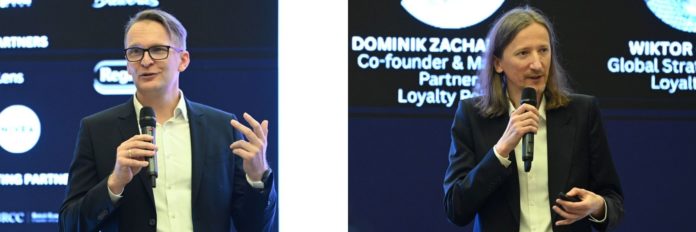
Retailers across Central and Eastern Europe may be wasting up to 50% of their promotional budgets, according to insights shared by Dominik Zacharewicz (Co-founder & Managing Partner) and Wiktor Goliszek (Global Strategy Director) from Loyalty Point. Speaking during the Future Retail & FMCG Forum organized by The Diplomat-Bucharest, the experts argued that loyalty programs should function as data-driven decision engines, rather than simple discount systems.
Loyalty Point has spent more than a decade designing and operating loyalty programs for retailers such as IKEA, Decathlon, Vision Express, and Maxima Group. Drawing on audits of client data, the company found that many promotions are offered to customers who would have purchased anyway, effectively eroding margins without changing behavior.
Three Levels of Loyalty Maturity
According to the speakers, most retailers fall into one of three categories. “Blind discounters” operate without meaningful loyalty programs and make marketing decisions based largely on assumptions. “Data collectors” gather customer information through digital loyalty systems but rarely use it operationally. Only a smaller group of “optimizers” actively analyzes customer data to personalize offers and measure results.
“The loyalty program is not the card or the points system,” Zacharewicz said. “It should be the nervous system of the company that helps decide who should receive which promotion and when.”
Data Can Transform Retail Performance
In one case study, a food retailer with around 1,000 stores launched an app-based loyalty program and quickly gained two million members. With customer data in place, the company began targeting offers based on purchase behavior and communication preferences.
Instead of discounting products customers already bought regularly, the retailer promoted higher-margin private-label alternatives. The strategy resulted in 24% higher engagement with marketing communications, a 4% increase in transactions, and 5% incremental margin growth.
For businesses operating on narrow retail margins, that increase can be transformative, the speakers noted.
Predicting Major Purchases
Another example involved a furniture retailer where shoppers tended to wait for large promotional events before making major purchases such as kitchens. By analyzing loyalty data, the company identified signals indicating when customers were preparing for large home-improvement projects.
Personalized incentives—such as free delivery or design consultations—were introduced only when customers appeared likely to abandon the purchase journey. The targeted approach generated 61% incremental sales, while avoiding unnecessary discounts for customers already likely to buy.
From Cost to Investment
The Loyalty Point executives concluded that retailers could move from basic loyalty programs to advanced data-driven systems within six to twelve months. The key step is conducting a comprehensive data audit and building a business case that focuses on incremental profit rather than program costs.
“When companies start discussing loyalty programs as an investment that generates measurable profit, the conversation changes completely,” Zacharewicz said.