
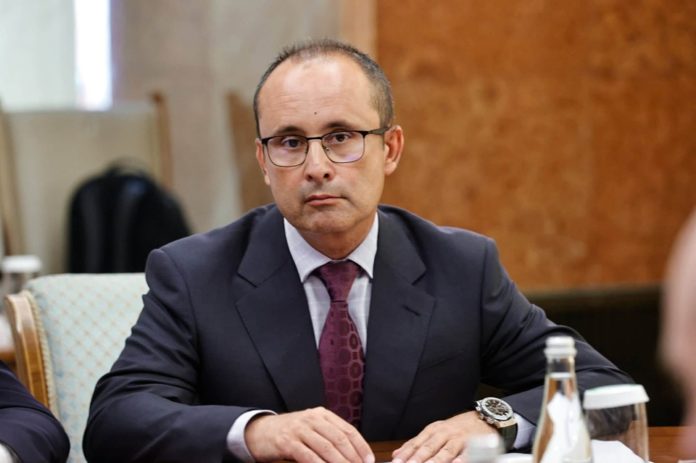
Romania has raised concerns over the country’s electricity supply security at European level, amid the imminent shutdown of Unit 2 of the Cernavodă nuclear power plant and recent developments in the regional energy system, Secretary of State at the Ministry of Energy Cristian Bușoi said Tuesday.
Bușoi said he took part in the European Commission’s Electricity Coordination Group, the European-level coordination structure for electricity security, where he presented the situation in Romania and the measures adopted by the Romanian Government to manage the expected impact.
“I presented the situation in Romania, the imminent shutdown of Cernavodă Unit 2, as well as the legislative measures adopted by the Romanian Government to manage the situation,” Cristian Bușoi said.
Romania activated the “early warning” mechanism on Friday, amid recent developments at regional level, and subsequently notified the European Commission of the next level, “crisis situation,” under Article 14(2) of Regulation (EU) 2019/941 concerning risk-preparedness in the electricity sector.
Against this backdrop, Romania has asked the European Commission and the European Network of Transmission System Operators for Electricity (ENTSO-E) to carry out an updated regional assessment of the electricity system.
According to Bușoi, the assessment should focus primarily on available generation capacity, balancing reserves, cross-border interconnection capacity and the ability of neighbouring countries’ electricity systems to provide support if the regional situation deteriorates further.
“We have requested an updated regional assessment by the European Commission and ENTSO-E, covering available generation capacities, balancing reserves, cross-border interconnection capacities, as well as the ability of neighbouring countries’ power systems to provide support should the regional situation deteriorate further,” Bușoi said.
Romania has also called for greater clarity on the actual availability of emergency assistance mechanisms between transmission system operators (TSOs) in neighbouring countries.
“It is important to clarify and continue discussions on the effective availability of emergency assistance mechanisms between transmission system operators in neighbouring countries, including the early identification of any technical or other constraints that could affect the activation and delivery of such support when required,” Bușoi said.
The Romanian official also requested that a technical bilateral meeting with the European Commission be organised at short notice to examine all instruments and mechanisms available under the European Union’s legislative and institutional framework that could be mobilised should the situation worsen.
These could include, according to Bușoi, measures involving the electricity market.
“We have requested a technical bilateral discussion with the European Commission at short notice in order to analyse in detail all the instruments and mechanisms available within the EU legislative and institutional framework that could be mobilised in the event of a further deterioration of the situation, including certain interventions in the electricity market,” he said.