
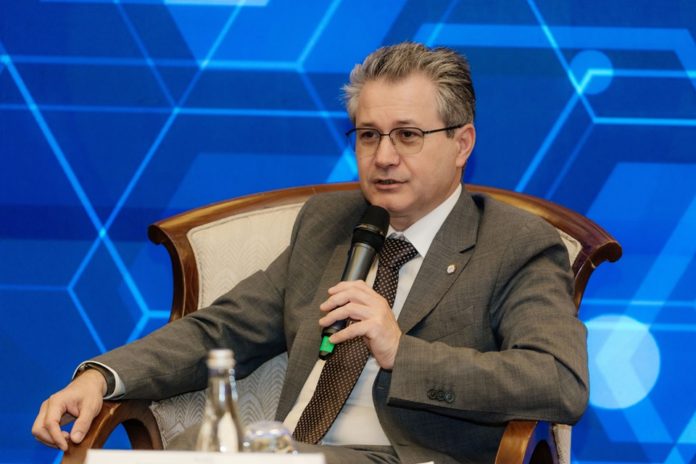
Romania needs a modern and flexible innovation funding framework aligned with European and global best practices if it is to strengthen its research ecosystem and competitiveness, according to Mihnea Costoiu, Rector of the University POLITEHNICA of Bucharest.
Speaking at Innovation Forum 2026, organized by The Diplomat-Bucharest, Costoiu highlighted key structural challenges facing Romanian universities and the country’s innovation ecosystem, while calling for reforms that would enable academia and industry to work more closely together.
Costoiu said he has been working with leading European policymakers on the future of the continent’s competitiveness.
“For a long time, I have been involved in various European and international bodies. More recently, we have been working together with the three well-known European rapporteurs—Mario Draghi, Enrico Letta and Manuel Heitor—on a new report on European competitiveness and European models.”
Despite ongoing discussions at the European level, Costoiu argued that neither Romania nor Europe has yet developed an effective mechanism to finance innovation.
“Unfortunately, we still do not have the answer I would like to see regarding the financing mechanism for Romanian innovation. The reality is that Europe itself does not yet have a truly robust solution, but that is not an excuse. The most important issue is not the amount of money available, but the absence of the right funding mechanism. We are still operating within a historically outdated paradigm, and we want to see this financing model adapted in Europe, as it has been in the United States and Asia.”
The rector also called for Romanian universities to enjoy the same legal opportunities as their European counterparts in developing innovation ecosystems, including start-ups and spin-offs.
“I hope we will find an answer as to why Romanian universities should not have the same legal rights as our colleagues across Europe. When we talk about innovation ecosystems, start-ups and spin-offs, we need to explain that not every euro invested in research is expected to generate an immediate financial return.”
According to Costoiu, one of the biggest obstacles remains the expectation that research investments should deliver immediate measurable profits.
“It is difficult to explain to some oversight bodies that if you invest one euro in research today, you cannot expect two euros back tomorrow. That is simply not how research and innovation work. Even if only 5 to 7 percent of projects achieve significant commercial success, that is already an excellent outcome.”
Costoiu also challenged companies to become more actively involved in university life, emphasizing that partnerships should go beyond financial support.
“The question is: what more should universities do to encourage companies to become more present on campus? Financial support is, of course, important, but that is not the main issue. The presence of companies within universities is essential for new generations.”
He noted that rapidly evolving technologies require universities and businesses to work together more closely to ensure graduates are prepared for changing market demands.
“Technology changes every single day. What we teach today may no longer be relevant tomorrow. We are extremely flexible and fully open to adapting our collaboration models because we have learned over the years that what works for one company may not work for another. We want companies to join us in building and expanding a dynamic innovation hub.”