
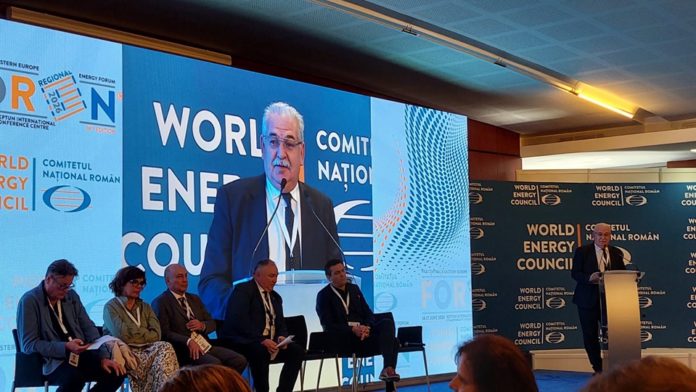
Growing electricity demand, supply chain constraints, workforce shortages and the need for stable market mechanisms are among the most pressing challenges facing the energy sector, according to Petru Ruset, Managing Director, Siemens Energy Romania who addressed industry leaders during FOREN 2026.
Speaking at the conference, Ruset argued that successfully addressing global energy challenges requires not only advanced technology but also a market environment capable of evolving alongside the sector.
“If we want to respond to the challenges coming from the global level, we need a market that grows together with the industry,” Ruset said. “It is not enough to have world-class technology if we do not fully understand the market in which we operate. Competition remains extremely important.”
According to the Siemens Energy executive, Romania’s energy sector is heavily influenced by geopolitical developments, particularly the war in Ukraine and tensions in the Middle East.
“Romania is strongly affected by the war between Russia and Ukraine and by developments in the Middle East,” he said. “We cannot ignore these realities when discussing the future of the energy sector.”
Ruset identified supply chain disruptions as one of the biggest risks affecting energy projects worldwide, warning that increasing costs are often driven by shortages and global market pressures rather than technology suppliers.
“The supply chain is the most critical risk factor in the delivery of energy projects,” he said. “Very often technology providers are blamed when prices increase, but in reality supply chain costs are rising significantly. This is a trend that Romania should monitor much more closely.”
He also highlighted the growing importance of capacity remuneration mechanisms as a tool for supporting investment in new generation assets and ensuring security of supply.
“If we choose not to align ourselves with global trends, we risk falling behind,” Ruset said. “Several important European countries have already adopted capacity markets, including Poland and Belgium, while others such as Germany, Sweden and the Czech Republic are moving in the same direction.”
According to Ruset, financing institutions are increasingly focused on the long-term viability and predictability of energy projects.
“Banks and financial institutions quantify risks very rigorously,” he said. “They want to know how secure the energy delivery is, at what price, for how long, and how long a generation asset can reliably operate.”
Despite concerns regarding project delivery, Ruset emphasized that large-scale energy investments can be completed on schedule when properly structured.
“Projects can be delivered on time if they are financed correctly and planned correctly,” he said.
Another major challenge identified by the Siemens Energy executive is the sharp increase in global electricity demand, which is creating pressure across the entire energy value chain.
“The growth in global energy demand is a challenge that perhaps we do not emphasize enough,” he said. “It creates two major effects: significant pressure on prices and supply chains, and significant pressure on the human resources needed to design, analyze and execute projects.”
Ruset warned that achieving long-term energy transition objectives will require substantial investments not only in infrastructure but also in talent development.
“If we want to double the amount of energy produced globally by 2050, we must also think about doubling the workforce dedicated to the sector—across utilities, contractors and suppliers,” he said.
Highlighting Siemens Energy’s contribution to the global energy transition, Ruset noted that the company employs approximately 2,000 engineers who support both international and Romanian energy projects.
“Siemens Energy has 2,000 people working in engineering for the global energy market as well as for Romania,” he said. “I am proud to represent a company that had the vision to invest in energy expertise long before anyone believed we would see the level of energy demand we are experiencing today.”