
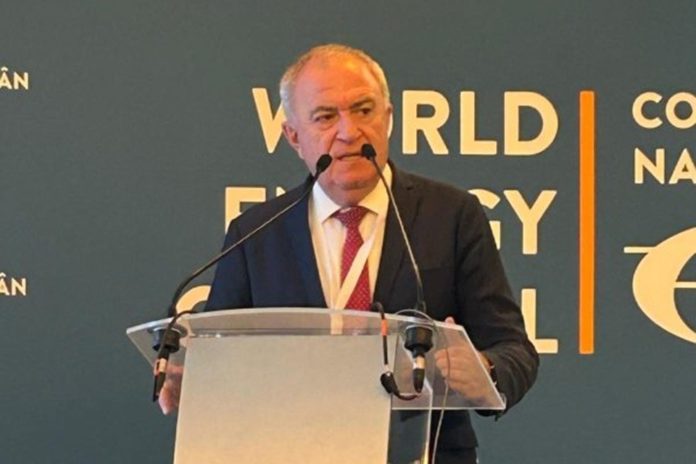
Transgaz has invested more than 3 billion euros over the past seven to eight years, significantly enhancing the security of gas supply for Romania as well as countries across Central and Eastern Europe and the Balkans, according to Ion Sterian, General Manager of Transgaz.
“Over the last seven to eight years, Transgaz has invested more than 3 billion euros. These investments have strengthened the security of gas supplies for Romania and for countries in Central and Eastern Europe and the Balkans,” Sterian said during the FOREN 2026 energy conference.
Highlighting the company’s contribution to regional energy integration, Sterian noted that Romania, through Transgaz, invested more than 475 million euros in connecting the Republic of Moldova to the Romanian and European gas transmission networks.
“I would like to remind everyone that Romania, through Transgaz, invested more than 475 million euros—based on 2019–2020 investment values—in the Republic of Moldova. As a result, Moldova was connected to Romania’s national transmission system and, through it, to the European gas network. Today, it has the independence to import gas from any sources it chooses,” he said.
Sterian also emphasized the strategic importance of the Black Sea–Podișor pipeline and the BRUA corridor, which together represent investments of nearly 1 billion euros.
“The Black Sea–Podișor pipeline and the BRUA corridor represent investments of almost 1 billion euros. We have been ready to receive Black Sea gas since the beginning of October last year. The pipeline is operational, it is already transporting gas, and it ensures transit flows to Hungary as well as supplies to the communities connected along its route,” he stated.
Addressing earlier concerns that the BRUA pipeline would merely serve as a transit route, Sterian stressed that the infrastructure was designed to support domestic development as well.
“When BRUA was being built, some claimed it would become a highway transporting gas straight out of the country. BRUA is not, and will not be, a highway without exits. We have connected all administrative-territorial units, local communities, and major investment projects that submitted requests to Transgaz for grid connection agreements,” he said.
Looking ahead, Sterian forecast a significant increase in Romanian gas demand during the winter season, driven by new gas-fired power generation capacity and the expansion of gas distribution networks.
“According to our analyses, Romania’s gas consumption between November 1 and March 31 will increase by between 800 million and 1 billion cubic metres. This is because a large number of gas-fired electricity generation facilities are coming online, and many localities have been connected to gas networks through the Anghel Saligny programme, alongside Transgaz’s investments in expanding the national transmission system,” Sterian said.