
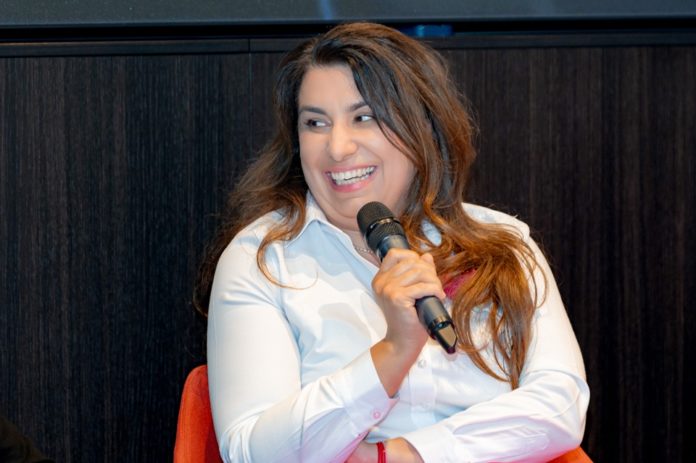
Advances in artificial intelligence and workplace technology are expected to drive greater efficiency in office utilization, but they are unlikely to fundamentally change companies’ need for physical office space, according to Maria Badea, Senior Leasing Manager at VASTINT Romania.
Speaking at the Workplace of the Future conference organized by The Diplomat-Bucharest, Badea said that while hybrid work and AI-driven automation are reshaping workplace strategies, human interaction remains a core reason employees continue to gather in office environments.
“Technology will help, but it will not fundamentally change behavior when it comes to the need for office space,” said Maria Badea. “In the past, 50 employees might have occupied 800–1,000 square meters. Today, through more efficient space planning, hybrid work models, and the introduction of AI agents that can partially replace certain functions, those same 50 people may fit into 500–600 square meters, with much better-structured areas and a greater degree of outsourced services.”
According to Badea, companies are increasingly reconsidering how much space they dedicate to traditional meeting facilities within their own offices.
“We will no longer see very large meeting areas being created within tenants’ spaces,” she said. “This is something we have observed over time—it is simply not efficient. That observation inspired us to develop The Venue, a product we delivered that has been very well received by the community. Today, many of our tenants’ internal events take place there.”
She added that technology plays a central role in enabling such shared facilities. “These events are supported by technology, of course, because everything you see here is powered by technology,” Badea noted.
Reflecting on workplace evolution since the pandemic, Badea said employers continue to search for effective ways to bring employees back to the office, while balancing the benefits of digital tools and flexible work arrangements.
“After 2020, we all went through a learning process, and in many ways a re-learning process,” she said. “Then, with the arrival of ChatGPT in 2022, we were pushed even further toward digital transformation. However, I believe it is also forcing us to return to some basic principles. We like technology, we want to implement it, it is useful and it can help us, but in the end, we still need human interaction.”
Badea said that tenants are increasingly looking for ways to encourage employees to spend more time in the office through community-building initiatives and events.
“We can see our tenants’ desire to bring people back to work by creating events for them and by partnering with landlords, as we do, to create experiences that foster engagement and collaboration,” she said.
Commenting on the growing adoption of artificial intelligence in the workplace, Badea emphasized that AI should complement, rather than replace, human judgment.
“AI helps a great deal,” she said. “With a simple question and a well-prepared prompt, it can provide valuable solutions. But critical thinking must remain part of the process. I believe we have a responsibility to teach the next generation that decisions should not be made solely on the basis of an answer generated by AI.”
Badea concluded that while AI will continue to transform workplace operations and improve productivity, organizations must ensure that employees develop the analytical skills needed to evaluate and challenge AI-generated outputs.