
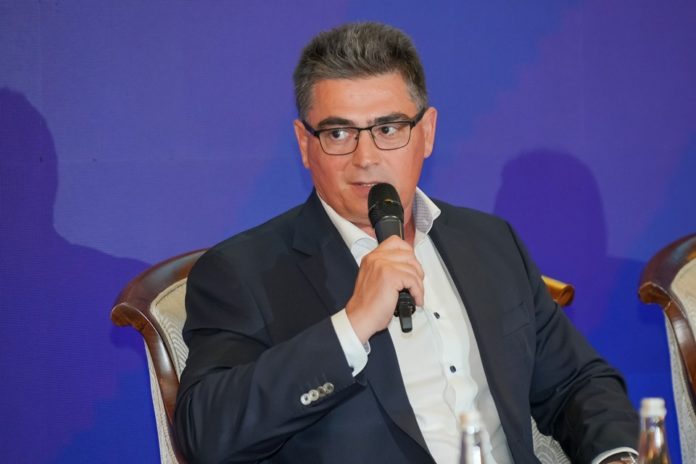
Romania’s rapidly expanding renewable energy sector is facing significant challenges related to workforce shortages, equipment supply chains, grid capacity and regulatory bottlenecks, according to Christian Leonte, CEO of Waldevar Holding.
Speaking at the Energy CEO Forum organized by The Diplomat-Bucharest, Leonte said the industry’s growth is creating unprecedented demand for highly specialized professionals.
“One of our main challenges is human resources. Not only in the energy industry, but especially here, we are facing a major shortage of qualified personnel. We need engineers, project managers, SCADA specialists and BESS experts for energy storage systems – a profession that did not even exist five years ago,” Leonte said.
He emphasized that companies must take a proactive approach to talent development and workforce planning.
“At Waldevar, we have done a very good job of attracting highly skilled professionals and expanding our team, not only in terms of numbers but, more importantly, in terms of the quality of expertise we bring into the company,” he added.
Leonte identified equipment procurement as another critical challenge, particularly the availability of transformers, which are essential components for renewable energy projects.
“Transformers have a major impact on project execution. We are talking about delivery times of up to 18 months. This means that for a project scheduled to be completed by the end of 2027, orders need to be placed today. Unfortunately, that is often not happening. We continue trying to absorb all previous delays at the final stage of project delivery,” he said.
Grid infrastructure remains another major obstacle as renewable generation capacity expands across Romania.
“There are many projects being developed in regions that are highly suitable for wind and solar generation. However, without the ability to evacuate and transport the electricity produced, these projects have no value. Significant investments and considerable effort have been wasted because of insufficient grid capacity,” Leonte noted.
He also pointed to regulatory and permitting challenges, arguing that some administrative requirements are difficult to meet under current conditions.
“Authorities now require developers to obtain construction permits within 12 months of receiving the grid connection permit. In most cases, this is nearly impossible, and the delays are not caused by the companies operating in the sector,” he said.
According to Leonte, 2025 marked a record year for renewable energy deployment in Romania, with approximately 2.2 GW of new renewable capacity added, compared with annual additions of around 500 MW in previous years.
“Such growth creates a level of complexity that is much greater than a simple fourfold increase. It requires a very fast pace of execution, exceptional resources and advanced competencies. Managing this efficiently and intelligently will be one of the sector’s biggest challenges,” he said.
While artificial intelligence is expected to support the industry, Leonte stressed that technology alone will not solve the sector’s challenges.
“AI will help us significantly, but it is only a multiplier. It is not the primary source of intelligence. Human intelligence will remain fundamental,” he stated.
Leonte highlighted Waldevar Holding’s own expansion as an example of how companies can respond to market demand.
“We have reached nearly 2,000 specialists while covering the entire value chain, from engineering and design to grid connection. We have already delivered five 110 kV substations and are currently designing 400 kV substations for Transelectrica, which we also hope to build. We have several additional substation projects under contract, allowing us to enter the top tier of the energy industry while addressing a critical market need,” he said.
Looking ahead, Waldevar plans to strengthen its position in emerging renewable technologies through local manufacturing.
“We will soon open our own factory for floating structures used in photovoltaic projects. The facility will supply equipment not only for Romania but for the wider region. We are already an important player in Europe and beyond,” Leonte concluded.