
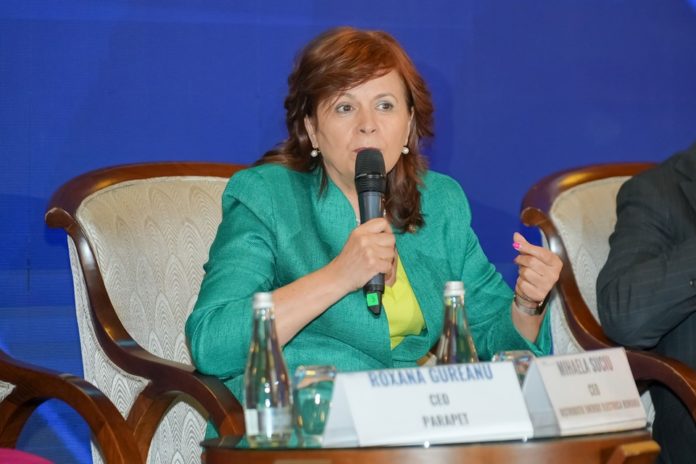
Romania’s energy transition can only succeed if investments in electricity networks keep pace with the rapid expansion of renewable generation and prosumer capacity, according to Mihaela Suciu, CEO of Distribuție Energie Electrică România (DEER).
Speaking at the Energy CEO Forum organized by The Diplomat-Bucharest, she highlighted the scale of DEER’s ongoing investment program and the urgent need to accelerate project implementation across Romania’s electricity distribution network.
“Distribuție Energie Electrică România currently has a very large number of projects under implementation. In addition to our regular investment program, recognized by ANRE in distribution tariffs and valued at approximately 150 million lei across 18 counties, we are also implementing projects financed through the Modernization Fund. The value of the contracts already signed amounts to 2.8 billion lei, of which 2.07 billion lei represents non-reimbursable funding. All these projects are now under implementation,” said Mihaela Suciu.
She emphasized that grid modernization is no longer optional but a prerequisite for achieving Romania’s energy transition objectives.
“We are investing in modernization because there is simply no alternative. The energy transition requires substantial investments in networks and digitalization. Without them, we cannot integrate the growing number of prosumers and power producers, nor can we increase the grid’s capacity to absorb renewable energy,” she stated.
According to Suciu, the expansion of renewable generation must be matched by parallel investments in transmission and distribution infrastructure.
“The energy transition is generating a significant number of obligations and projects. The pace of the energy transition should be aligned with the pace of network modernization and the expansion of generation capacity. If there is a vulnerability today that could hinder Romania’s transformation into a regional energy hub, it is the state of the transmission and distribution networks,” she said.
Suciu warned that investments in renewable energy alone will not be sufficient if the grid is unable to accommodate the additional capacity.
“There is little value in talking about prosumers and renewable energy producers if the networks are not prepared and do not have the capacity to integrate this green energy. At this stage, Romania should place the strongest emphasis on modernizing its networks and increasing their capacity to absorb renewable electricity,” she added.
The DEER CEO also called for faster execution of energy infrastructure projects, stressing that implementation speed has become one of the sector’s biggest challenges.
“We have no choice but to increase the speed of implementation. The speed of the energy transition must be equal to the speed at which projects are delivered. We have a very large project pipeline, and our objective—including in discussions with contractors and partners—is to complete projects ahead of schedule whenever possible. Many other projects are already waiting to move forward,” Suciu said.
While funding is available through both company investment programs and the Modernization Fund, execution capacity remains constrained.
“Everyone is focused on project implementation. Funding is available, although not yet sufficient, but implementation speed must increase. Contractors, regulators and distribution operators all need to be involved in this effort. Accelerating implementation is the only solution available to us,” she noted.
Suciu pointed out that Romania’s distribution infrastructure, particularly medium- and low-voltage networks, requires extensive modernization.
“We are already lagging behind the pace of generation capacity deployment. Medium- and low-voltage networks are very old and require significant upgrades. At the same time, execution capacity is limited. There are numerous projects underway, and nearly all contractors in the market are already engaged in major energy infrastructure works,” she explained.
Looking ahead, Suciu also underlined the importance of developing the industry’s future workforce.
“Romania has an opportunity to increase the number of graduates from specialized technical universities, which is essential for meeting the workforce needs of the energy sector,” she concluded.