
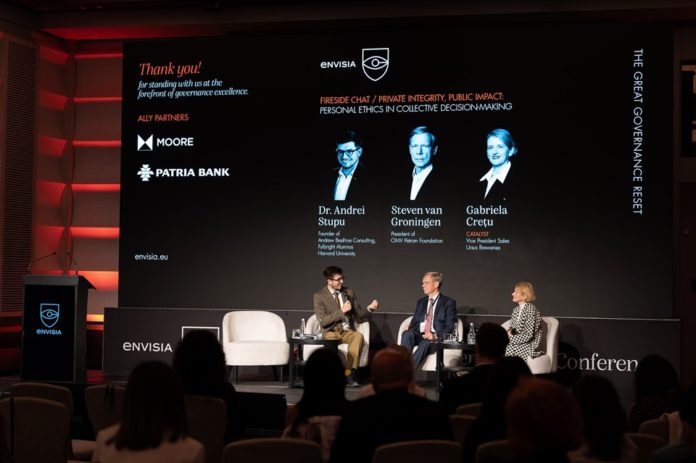
At Future of Governance 2026, business leaders and governance experts explored how ethical drift develops inside organisations — often gradually, systematically and under the pressure of performance
For years, corporate ethics was treated largely as a matter of compliance, codes of conduct and reputational management. But in an environment increasingly shaped by pressure, acceleration and institutional distrust, a more difficult question is beginning to emerge inside organisations: what actually happens when personal integrity collides with systems built around performance, incentives and operational pressure?
This question sat at the center of one of the most reflective conversations at Future of Governance International Conference 2026, organized in Bucharest by Envisia – Boards of Elite.
The fireside discussion, titled “Private Integrity, Public Impact”, brought together Steven van Groningen, President of the OMV Petrom Foundation and one of the most respected business leaders in the Romanian market, and Andrei Stupu, expert in moral intelligence and founder of Andrew Behive Consulting, in a conversation moderated by Gabriela Crețu, Vice President Sales Ursus Breweries.

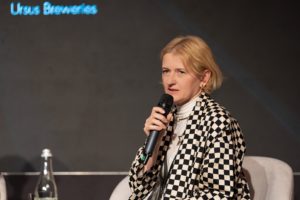
Positioned deliberately after a full day of discussions on governance frameworks, geopolitics and institutional transformation, the session shifted attention away from systems and toward the people operating inside them: leaders, teams and organisational cultures navigating increasingly difficult trade-offs.
Rather than focusing on abstract morality, the discussion explored the practical mechanics of ethical drift — how compromised behavior emerges gradually inside otherwise functional organisations.
Ethical erosion rarely starts with bad intentions
One of the strongest themes of the conversation was that most ethical failures do not begin with dramatic misconduct or malicious intent.
Instead, they develop incrementally through pressure, rationalization, silence, fragmented responsibility and repeated small compromises that slowly become normalized.
Drawing on the concept of “moral disengagement,” developed by psychologist Albert Bandura, Andrei Stupu explained how individuals can continue perceiving themselves as ethical while simultaneously participating in systems or behaviors they would reject outside those environments. “The more you try to convince yourself you are a good person, the higher the chances that you may become a bad person,” he argued during the discussion.
The conversation repeatedly emphasized that organisations themselves often create the conditions for ethical deterioration — not necessarily through explicit misconduct, but through cultures where pressure, incentives and performance gradually overshadow reflection and accountability.
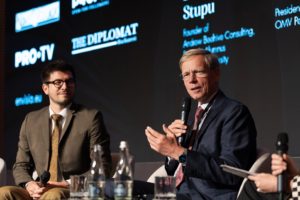
Steven van Groningen pushed the discussion further by introducing a distinction he believes is still insufficiently discussed in business environments: not only moral disengagement, but amorality.
Referring to the long-standing influence of Milton Friedman’s doctrine that companies exist primarily to maximize shareholder value within legal boundaries, he argued that many organisations stopped asking ethical questions altogether.“And that is not moral disengagement. That is amorality. You don’t even ask yourself whether moral aspects play a role in business,” he said.
The discussion suggested that some of the most problematic decisions inside organisations emerge not because people deliberately choose unethical behavior, but because ethical reflection itself slowly disappears from operational environments.
Organisational culture matters more than value statements
Another important thread of the discussion focused on the relationship between individual values, organisational culture and leadership systems.
Andrei Stupu argued that values become real not through slogans or corporate declarations, but inside what he described as “micro-moral ecologies” — the small environments where leadership reactions, incentives and social expectations shape behavior every day.
Drawing on the universal values framework developed by psychologist Shalom Schwartz, he explained that concepts such as honesty, fairness or respect may exist universally, but organisations frequently fail to define concretely how those values translate operationally into decisions and behavior.
“It’s impossible for an individual to act ethically if they do not align their own values with the values of the communities they enter,” he explained.
Moderating the conversation, Gabriela Crețu repeatedly redirected the discussion toward practical leadership responsibility: how organisations operationalize values, what types of behavior they reward under pressure and whether institutions genuinely create environments where ethical behavior is realistically possible.
One of the central ideas emerging from the panel was that organisational culture is not built primarily through official messaging, but through repeated behavioral signals: what leadership tolerates, rewards, ignores or punishes over time.
Performance pressure often creates the conditions for silence
The conversation also examined how traditional performance systems may unintentionally encourage ethical compromise.
Steven van Groningen reflected on situations where organisations tolerate toxic or unethical behavior from high-performing individuals because commercial results remain strong. “What you are doing is poisoning the water you are swimming in,” he said while discussing leadership teams unwilling to confront harmful behavior when short-term business outcomes appear favorable.
The discussion explored how many organisations continue operating through “stick and carrot” management systems that reduce people to targets, incentives and punishments. According to both speakers, such systems often discourage transparency, feedback and early error recognition — precisely when organisations need them most. The Wells Fargo scandal was referenced as a clear example of how unrealistic performance targets can distort behavior at scale without explicit malicious intent at the individual level.
Another major theme concerned the distinction between intention and consequence. Good intentions alone, the panel argued, do not eliminate ethical responsibility when organisational decisions produce systemic harm.
The fireside discussion also emphasized the importance of psychologically safe environments where concerns, mistakes and ethical tensions can be surfaced before they escalate into institutional crises. “If people are punished every time they make a mistake, they will simply stop reporting problems,” Steven van Groningen argued.
Ethical leadership requires reflection, not only rules
The final part of the conversation focused on leadership responsibility and the role reflection plays in ethical maturity.
Andrei Stupu argued that moral intelligence cannot be developed through isolated compliance trainings alone. Ethical maturity requires self-awareness, continuous reflection and environments capable of sustaining difficult conversations openly.
He also warned that hyper-fragmented modern environments — dominated by constant stimulation, speed and information overload — increasingly reduce people’s capacity for reflection, making ethical disengagement easier and moral clarity more difficult.
“We do not become wise through the quantity of experiences we accumulate, but through the quality of reflection we apply to them,” he said.
Across the conversation, integrity emerged less as a question of perfection and more as a long-term leadership discipline requiring courage, transparency and the willingness to examine how organisational systems shape human behavior under pressure.
The full fireside discussion “Private Integrity, Public Impact” can be viewed here: https://youtu.be/IBT6w4bJsWc?si=2GuvTy54bpUGJuvi
The Future of Governance International Conference 2026 is part of the broader ecosystem developed by Envisia – Boards of Elite, which includes executive education programs, governance initiatives and the Envisia Connect community platform dedicated to board members, senior executives and governance professionals.
About Envisia
Envisia – Boards of Elite is Romania’s first business school dedicated to corporate governance and the professionalization of board members. Around it, an active community of alumni and leaders has emerged, one that accelerates learning, collaboration and long-term impact.
Through internationally accredited programs, including the globally triple-accredited postgraduate program delivered together with Henley Business School, as well as the local Corporate Governance that Creates Value program, developed in partnership with Romanian-American University and Bucharest Stock Exchange, alongside masterclasses and media initiatives, Envisia develops leaders who transform governance principles into performance and trust.
For more information: https://www.envisia.eu/en