
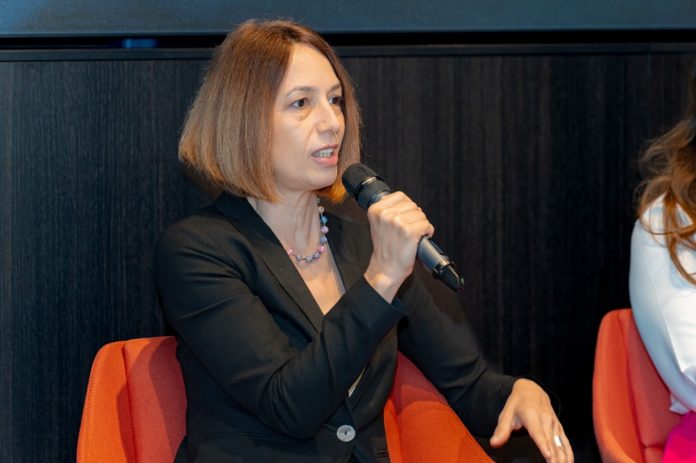
Human resources professionals are facing a new reality as artificial intelligence has become an increasingly common source of information for employees, according to Monica Slincu, HR Director at INFORM, member of AUSTRIACARD HOLDINGS. Speaking at The Diplomat-Bucharest’s Workplace of the Future conference, she said AI is reshaping employee expectations and placing additional pressure on HR teams.
“Beyond the resilience required from HR teams to explain details that employees now check or ask an AI about, there is also the situation where people come to Human Resources and question your competence,” Slincu said. “An AI will always appear superior to a person who may be tired, make mistakes, not have all the information at hand, or simply forget a detail on a given day. This creates an additional layer of pressure on HR professionals.”
She added that the HR function itself is still adapting to the rapid pace of technological change.
“Personally, I am not convinced that we in HR are fully prepared,” she said. “We are moving alongside this trend: employees are testing new technologies, they are testing us, and we are testing different tools ourselves. We are trying to bring everything together to become more agile and deliver better internal services to employees.”
Looking ahead, Slincu believes the coming years will reveal both the strengths and limitations of AI, while highlighting the importance of human skills and values.
“In the next few years, we will gain a clearer understanding of how successful AI development has been and how successful we have been in reprogramming ourselves in terms of human competencies and values,” she noted.
Addressing broader workforce trends, Slincu argued that employers are recruiting from the same talent pool and facing similar challenges with younger generations whose educational experiences have been shaped by the pandemic and changing social norms.
“We are all recruiting from the same market,” she said. “We are recruiting younger generations with different expectations, many of whom spent years learning remotely during the pandemic. Even today, some children attend school only part of the week, and absenteeism is often tolerated. These are behaviors learned from an early age and, in some cases, reinforced by the education system itself.”
She suggested that employers should examine the wider societal factors influencing workforce engagement rather than focusing solely on candidate behavior during recruitment.
“When candidates fail to show up for interviews, perhaps we should not only ask why they do not come, but also what we can do as a society at a more fundamental level,” Slincu said. “If we expect people in the future to sustain the effort of going to the office five days a week, we should also consider the habits and expectations being formed much earlier in life.”
On employee experience, she emphasized that a one-size-fits-all approach is unlikely to succeed.
“Very few employees experience initiatives address all categories of workers equally,” she concluded. “What may resonate with a white-collar workforce can be very different from the activities and experiences that are meaningful for blue-collar employees. This is a much broader conversation that organizations need to have.”