|
March 2010
Missile shield raises new nuclear arms race fears
Iran hits back at US plans to hold a missile shield on Romanian soil, stoking fears of a new nuclear arms race. Report by Michael Bird
Iran fears that the installation of a US missile defence system in Romania could contribute to creating a new nuclear arms race in the region.
According to the USA, Iran is creating a medium-range ballistic missile, the Shahab 3, with a 2,000 km range capable of attacking NATO allies Greece, Romania and Bulgaria.
Development of these weapons could be ready by 2015, according to US intelligence, while the west and Israel remain concerned that Iran has plans to produce nuclear material for the missiles.
Currently, the USA believes the greatest threat from Iran will be to US allies and partners and to US military and civilian personnel in the Middle East and Europe.
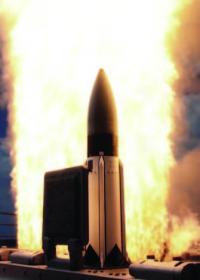
This has prompted the USA to green-light a defence system of 24 Standard Missiles (SM-3) on a land-based platform in Romania by 2015, which aims to knock out the Shahab 3s in mid-air.
The Romanian installation is the first tangible security guarantee from the USA for Romania and rewards the EU country for its strong military and political support of USA and NATO ventures in Iraq and Afghanistan.
Romanian President Traian Basescu was vague in phrasing against whom the system was defending his country. He said the shield “comes in response to new categories of threats”. Basescu said the system did not target Russia, but he made no mention of Iran.
A statement from the Islamic Republic of Iran, sent through its Romanian Embassy to ‘The Diplomat – Bucharest’ details what Iran believes is the hypocrisy of this project and fears that this could create a new nuclear arms race in the region.
“On the one hand, the missile shield project in the Balkan region has been justified as a defence system but, on the other, when the Islamic Republic of Iran has tried to enforce its defence system, it was confronted with a series of accusations and restrictions,” reads the Republic’s statement.
The comment adds that Iran is “facing groundless accusations” - seeming to refer to allegations of Iran’s uranium enrichment programme for military purposes - and is being characterised as a threat, even though the Islamic Republic has declared its military strategy is defensive.
“Isn’t this a blatant case of double standards and an attempt to deceive public opinion?” claims Iran. “Aren’t the exaggeration of imaginary threats and the development of the anti-missile shield project... going to create a new nuclear competition in the region and in the world?”
Iran has argued it is creating a uranium enrichment programme for peaceful use, but there is now a fear it could use the US acceleration of arms in the region as a pretext to embolden its own military arsenal, potentially with nuclear material.
“For Romania, if Iran is close to nuclear capability, then this is the most important and closest threat,” security analyst Iulian Chifu has argued. “Romania needs to have viable capabilities to face this threat.”
However Eugene Chausovsky, Eurasia analyst for global intelligence company Stratfor, believes the main security threat to countries in central and eastern Europe, such as Romania and Poland, comes - or is perceived to come - from Russia.
Who wins from the shield?
This decision consolidates relations between the USA and Romania. It indicates that Romania is one of the strongest allies of the US in eastern Europe.
Romanian Prime Minister Emil Boc called the arrangement a political, diplomatic, military and strategic success. “The costs are minimum, but the benefits are maximum for Romania,” he said. It is a vote of confidence from the USA in Romania’s political stability and security at the NATO and EU border. There have been no public protests in Romania against the decision. Broadly speaking, all the political parties are in favour of the missile shield. Ex-president of Romania Ion Iliescu expressed mild dissent by indicating that Parliament could call for a referendum on the plan, but this is not necessary. Instead the missile shield will only need Parliamentary approval.
Who loses from the shield?
Iran’s relationship with Romania is under threat, although a statement from the Islamic Republic suggests that the blame for the shield rests with “domineering and hegemonic” countries, which implies the USA and possibly Israel.
With this installation in place, Romania is on the map as a terrorist target in the Balkans for groups looking to take a hit at the USA. However it is unlikely to be as sensitive as the UK or USA, because acts of terrorism in these countries have greater news value than in Romania. Terrorists in Romania would probably focus on the nation’s nuclear power station at Cernavoda. But one security analyst states that: “Cernavoda could be a target, but no more than [nuclear power plant] Sellafield in the UK.”
The missile shield will not help negotiations for the construction of the Nabucco gas pipeline project between Austria and the Caspian Sea via Romania and Turkey. It could put in danger the development of the pipeline when two of the potential stakeholders – Iran and Romania – are pointing missiles at one another.
However Chausovksy argues that there is “no strong correlation” between the missile defence system and Nabucco, because the project faces more direct challenges, such as finalising the source countries. The producers of the gas could either be Iran or its neighbours Azerbaijan and Turkmenistan, all of whom are in debate over maritime borders above gas reserves in the Caspian Sea.
Contacted by The Diplomat, neither representatives of the Nabucco consortium nor Nabucco’s Ambassador-at-Large would answer questions on the security implications of the defence shield on their pipeline.
Russian suspicion
Russia’s rhetoric is not outward acceptance of the Romanian proposal. It says it is “concerned” by Romania’s decision to host interceptor missiles. Russian Foreign Minister Sergei Lavrov demanded an “exhaustive explanation” from The White House.
This is a change from the hostility Russia demonstrated in 2007, following the US decision to host a missile shield in Poland and the Czech Republic. Russia then threatened to put its Iskander missiles in Kaliningrad to counter the Polish shield.
Following the Romanian announcement, Igor Smirnov, president of breakaway Moldovan republic Transnistria, offered to host Russian Iskander missiles on his territory - but was rebuffed by Moscow.
Security experts argue that Russia has been “in the loop” in regard to discussions on this new missile shield in Romania. But it would be unseemly for Russia to show too much enthusiasm for the new deal.
However Russia will remain suspicious of any acceleration of arms in eastern Europe, especially when Obama is trying to negotiate a global reduction in the quantity of nuclear weapons. “These alliance developments [between USA and Romania] have not been met lightly by Moscow, with Russia expressing concern and seeing the placement of the missile defence system as a risk to its security,” argues Chausovsky. As we went to press, Russia was also set to deliver its S-300 Patriot missiles to Iran, in a deal opposed by Israel and the USA.
But publicly, the USA welcomes Russian cooperation on missile defence to create a broader defence of NATO and Russia’s common strategic interests. Last September NATO Secretary General Anders Fogh Rasmussen stated: “We must all aim for a Euro-Atlantic security architecture in which Russia sees herself reflected.”
The US wants to integrate this architecture with NATO members’ missile defence capabilities – a plan which was discussed at the last two NATO summits. A senior NATO figure told The Diplomat last November that NATO would only work on its complementary shield when it was clear what US anti-missile system would be in place.
Once the SM-3s are deployed in Romania, Iran will be facing a stern arsenal from three positions at Europe’s borders. This includes US Aegis ships in the Mediterranean, which also carry SM-3s, a land-based system in Romania and Israel’s anti-missile ‘Arrow’ system. Turkey is buying an anti-ballistic missile system from US firm Lockheed Martin - Patriot Advanced Capability 3 - but must not indicate this is against its neighbour Iran.
There is a concern among analysts that a further NATO missile defence shield in the region could lead to overcrowding.
Obama defence: the flexible approach
A land-based Standard Missile 3 (SM-3) installation in Romania is part of Barack Obama’s ‘Phased, Adaptive Approach’ (PAA) against an Iran missile threat, which will be accompanied by a new anti-missile base in northern Europe by 2018.
A radar is also part of the system, which Romania will not host. The USA has indicated this radar could be placed in the Caucuses, although Bulgaria may be an option.
The installation in Romania will have three interceptor batteries of eight anti-ballistic missiles (ABMs). Each missile will have a 600 km range.
This SM-3 land-based system is re-locatable and may be stationed in more than one place. But the precise technology is still under development.
Over the next 18 months the USA and Romania will finalise the location. The US military currently operates from the Mihail Kogalniceanu air base in Constanta county near the Black Sea. This is a remote place as geographically close to the potential threat as possible for Romania, and locations around or close to the base could be an option. Stratfor’s military analyst Nathan Hughes says it is “flexible” where in Romania the defence system could be but, because this is a new initiative, it is hard to be certain of locations.
The US is now deploying SM-3s on its Aegis ships in the east Mediterranean. The US cannot operate ships in the Black Sea as this would need diplomatic horse-trading with Turkey and Russia to overhaul the historical Montreaux Convention, which limits the time non-Black Sea state combat ships can spend in the zone.
This is a bilateral American-Romanian deal which overlaps on the security needs of the EU and NATO, in which Romania provides the location and the US provides the hardware. The USA will pay for the installation, while costs for Romania may include infrastructure, logistics or land purchase.
Iran′s response to the installation of a missile shield in Romania
Reply to questions regarding Iran’s view on the American missile shield to be installed in Romania, asked for by ′The Diplomat – Bucharest′ magazine
The Islamic Republic of Iran’s foreign policy relies on the principles of mutual respect and efforts to establish justice – in its true meaning – in the world and to refrain from any interference in other countries’ internal affairs. According to these ideas, our country has always tried to avoid the situations leading to increase of tension and to contribute to the development of spirituality, peace and justice in the world by seeking the help and collaboration of other actors of the international scene and by always observing the UN Charter while protecting its own national interests.
Unfortunately, some domineering and hegemonic countries have no interest in the establishment of peace in the world and, furthermore, are making accusations against other states, trying to take the advantage of international issues, through unilateralist actions. Now, when many countries are suffering the effects of the economic crisis and everyone’s efforts should be directed to solving these problems, it seems that these authoritarian countries are eluding them, by imposing their own will and illegitimate personal interests.
Declaring Iran as a regional and global threat is part of the same issue mentioned above and we are convinced that countries whose portfolio is filled with cases of serious infringements of human rights are the authors of plots that are becoming more obvious on the international scene and the public opinion throughout the world is more aware of their bad intentions and ill-will. One question that has been raised by the international public opinion refers to the fact that, on the one hand, the missile shield project in the Balkan region has been justified as a defence system but, on the other, when the Islamic Republic of Iran has tried to enforce its defence system, it was confronted with a series of accusations and restrictions. Why are a limited number of countries that own atomic weapons continuing to develop them with the latest generation technology, despite the international regulations?
And at the same time Iran is facing groundless accusations and is being nominated as a threat, even though Iran has repeatedly declared that its strategies and military system are strictly defensive. Isn’t this a blatant case of double standard and an attempt to deceive the public opinion? Aren’t the exaggeration of imaginary threats and the development of the anti-missile shield project, which is described as a connecting point between three continents, going to create a new nuclear competition in the region and in the world? Isn’t it going to revive the memories of the Cold War times, which left Romania as well with a bitter experience?
The historic relations between Iran and Romania, which can be traced back to the ancient times of Darius and other Persian kings, are completely devoid of any negative experiences. Also, during the period of more than a century of official diplomatic relations between the two countries, no conflicts or tensions have been witnessed, and the bilateral relations have always been founded on the principle of mutual respect.
There doesn’t seem to be any kind of conflict of interests in the relations between the two countries and the neutral political analysts, unbiased by the media propaganda, have admitted that such a context does not exist. On the other hand, history attests the fact that Iran has never followed hostile or aggressive politics in the Balkan area. During the last 150 years Iran has never initiated any conflict or war in the region or among his neighbours.
Therefore, we are convinced that maintaining the peace and avoiding any situations that create tension should be the grounds for the logical context of the bilateral relations, pursuing the long-term best interests of our two countries. The Islamic Republic of Iran is ready and willing to respect these principles in its relations with Romania and other countries in the region and we believe that some actions conducted by autocratic countries in the region and in the world have a subversive nature.
PRINT EMAIL
| COMMENTS |
There are 2 comments:
shirley: (shirley3199@gmail.com) on 2010-03-01 02:22:36 Romania already proved its sub servience to Us by running US torture prisons against EU lawsthis trouble maker along with Poland should be castigated for fear mongering and inflaming tensions.one would have thought these two countries would have learnt from war not promote it for their own inflated egos.and stupidity.there is nothing to be admired in being a US doormat.Us has admitted lying abouyt Irans nuclear program for years .Israel has rampped up the lies to bury the fact they were to blane for 9/11 nato just admitted Taliban had nothing to do with 9/11 so why are they still killing them /insread of exit stratergy.EU is becoming a racist killing machine and EU citizens are no better allowing their armies to be involved.this blantant disregard for human life is appalling.the plastic unquestioning arrogance of europeans.is to be despised. US let OB Laden escape2001 to continue war on terror this was proven recently.AL qeada top 3 are AMERICANS and could be anywhere.
kamadeva: (kamadeva66@yahoo.com) on 2010-03-02 17:33:16 Romania has nothing against Iran, this missile shield is aimed against Russia i can assure you of that; for much of the last 200years Russia was our enemy and IS our enemy.
Muslims are pretty much welcome in Romania as long as they follow the laws...which they do; Proof: Turkey has a priviledged partnership with Romania in many sectors of economy and turks love it here.
While i agree Romania does alot of things to prove itself to "the master" historically we always did that, we always sided with the strongest and betrayed them eventually, so don't worry, romanians do this to follow their own interest...which is: keep Russia at bay and have a leverage over it at the same time(it's very easy to switch from medium range interceptors to ICBM missiles and threaten "the bear")+ maybe provide safety against Iran in a possible future scenario(highly unlikely).
Romania also has interests in reuniting with Moldova...again something Russia won't be thrilled on.
good day.
|
|
|
PRINT EMAIL COMMENT
|
SEE ALSO:
July 2009
BUCHAREST While the volume of Bucharest’s modern retail space steadily increases, rents have declined by ten to 20 per cent between January and March 2010 against the same period of 2009, according to real estate consultants DTZ Echinox Exports of pork meat produced in Romania to EU states could begin again from September at the earliest, according to Mihai Visan, executive director of the Romanian Meat Association In the second half of June, Czech energy group CEZ started operating its wind park in Constanta county, generating power at 20 MW/h, eclipsing the rest of the installed wind capacity in Romania Binge-drinkers will be booking flights to Romania at the news that the country is the EU’s cheapest place for drinking alcohol, according to a Eurostat study Salary cuts and VAT hikes will surely be painful - but will they really be gainful?
Crisis report by Claudia Ciobanu Selling your company or part of its business can be a cumbersome process if not carefully prepared for in advance. Sellers should be aware that a significant amount of work must be dedicated to the pre-sale process, especially to the due diligence investigation conducted on the target company
|
|