The magazine for informed internationals
Vol 6, no. 1, February 2010

< back to homepage

November 2009

Missile threat shifts to Black Sea

How can America’s anti-ballistic missile architecture expand into the land and waters of the Black Sea region? Michael Bird reports

The transformation of America’s security architecture for eastern Europe has thrown Romania into the spotlight as a key strategic location for defence against the threat of medium-range ballistic missiles.
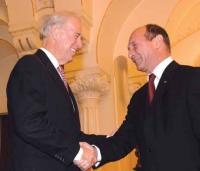
US vice president Joe Biden made the first moves into this direction when, on a recent visit to Bucharest, he welcomed Romania’s “embrace” of the new US proposals for combating short and medium range airborne weaponry.
But it was unclear whether this could translate into Romania hosting either a land-based anti-missile defence system or whether the Black Sea itself could support US or US-allied ships bent on defending the region against a missile assault.
The US believes there is a threat from Iran’s rapid development of its Shahab-3 missiles, which have a range of 2,000 km. This contains within its radius the potential targets of Israel and NATO members Greece, Turkey, Romania and Bulgaria, as well as Russia. The Shahab-3 could, theoretically, be fitted with a nuclear warhead.
“For Romania, if Iran is close to nuclear capability, then this is the most important and closest threat,” says Iulian Chifu, director of NGO Centre for Conflict Prevention and Early Warning. “Romania needs to have viable capabilities to face this threat.”
In Bucharest last month, Biden again highlighted the danger of missiles to US’s European allies. “This technology, coupled with the spread of nuclear know-how, poses a great threat to all of us,” he argued.
US defence secretary Robert Gates has also stated that candidate countries for a land-based defence system of standard missile-3 (SM-3) could be in eastern Europe. So far only the Czech Republic and Poland are officially on the shortlist, while Gates has also floated the idea of a radar system in the Caucuses.
“Romania would be able to give political and popular support for such a scheme,” says Chifu. “It is pro-American among both the people and the Government of any colour.”
Romania is a better strategic location than the Czech Republic and Poland because it is closer to the site of potential threats from the south and the east. “Romania and Bulgaria are more vulnerable from the point of view of a weak military equipment of their national armies,” says Radu Tudor, military analyst and Jane’s Defence correspondent for Romania. “A strong and modern surveillance system located in Romania, Bulgaria and Turkey could monitor three hot areas at once: the Black Sea, the Caucasus and the Caspian and relevant zones in the Middle East.”
There are competing missile defence systems in place and planned. The east Mediterranean has its own defence architecture, with Israel’s ‘Arrow’ system of interceptor missiles. While NATO has a long-term plan in missile-defence for the southeast European region, this is still at the draft stage and is waiting for the confirmation of the US plan. Meanwhile Turkey is also buying a billion-dollar radar and missile system from the USA, with its purchase of the air defence system Patriot Advanced Capability-3. Last October the US invited Turkey to join the new missile shield, but Turkey is very unlikely to host a land-based SM-3 system, because it would not dare position itself so aggressively against its Iranian neighbour.
This would make Greece, Bulgaria or Romania contenders - and with Biden making the recent visit to Bucharest as opposed to Sofia or Athens in the context of discussions on security architecture, Romania appears to be a more likely location.
But one analyst argues that the reason Biden does not want to make more of a public commitment to Romania as a host country at this stage is because the nation is locked in a Presidential campaign. Such a statement could imply a tacit approval from Washington for Basescu’s re-election. This is not a re-appointment that the US opposes - Basescu has been a strong, almost over-enthusiastic, ally of America - but the USA will not want to be seen as interfering.
Most analysts agree that a deployment of missiles in Romania would not be opposed by Russia, as such a location would not be as direct a threat as Poland and the Czech Republic. But dialogue with the eastern country is a necessity at every stage. “If the deployment of the new anti-missile shield in Romania will be part of the military agenda between the US and Russia, Romania’s relationship with Russia will not worsen,” says Liviu Muresan, president of Romanian security think tank Eurisc. “But if Washington’s security strategy in Europe will not be discussed with Moscow, there will be tensions between Romania and Russia.”

Naval moves

By 2011 the Pentagon will roll out its naval anti-ballistic missile system on cruisers and destroyers in the eastern Mediterranean. These ships will be equipped with Lockheed Martin’s Aegis system, containing anti-aircraft and anti-missile radar and weaponry. The ships contain the mid to long range SM–3 missiles.
But could these vessels also be extended to the Black Sea, taking into account the zone is in the range of the potential threat? Romania and Bulgaria offer the best potential locations for a marine base. The Constanta port and the naval facilities, plus Bulgaria with its Burgas port, could be good platforms for a military naval base, argues Radu Tudor. If the US wants to use naval facilities in Romania, Ioan Mircea Pascu, MEP and ex-Romanian Minister of National Defence, argues it should not consider building new facilities, but modernise existing ones for its cruisers and destroyers.
But most analysts argue that it would be impossible for the US to use its Black Sea allies as a location for naval defence without an overhaul of existing maritime agreements, because the US could be seen as intruding on Russia’s waters.
A major obstacle to US presence in the Black Sea is the 1936 Montreux Convention, a Soviet-era agreement giving Turkey control over the Bosphorus and Dardanelles Straits. It states that warships of non-Black Sea powers may not remain in the Black Sea longer than 21 days and prevents aircraft carriers from moving through the straits.
In 73 years Turkey has allowed some exceptions, but the principle remains in place. By limiting the Black Sea to naval vessels of the sea’s border states, the agreement gives Russians de facto control over the maritime area and Turkey administration over its own straits. The US’s presence in the Black Sea is still being tested. Most recently America was restricted from sending humanitarian aid by ship to Georgia during its conflict with Russia in 2008.
“Since August 2008 Russia has become an unpredictable actor and even ostentatious in manifesting its military aggression at the Black Sea,” argues Tudor. “I hope that the new American strategy will include not only the US direct interests but also an enhanced protection of the NATO member states which have an exit to the Black Sea.”
Most analysts believe a revision of the treaty is not possible. “It is part of Turkish foreign policy,” says Chifu. “Instead the US must have strategic partnerships in the Black Sea.” Any permanent US marine presence in the Black Sea would mean a serious shift in the security balance in the area. “This requires a political and strategic approach, not just a strictly military approach and thus it will not be seen any time soon,” says Pascu.
However the rhetoric at the highest level is moving in the direction of thinking the unthinkable on western-Russian relations.
Both the US and NATO are attempting to restart their relationships with Russia. Last September NATO Secretary General Anders Fogh Rasmussen used his maiden speech to call for Russian and NATO cooperation on missile defence in Europe. “We should explore the potential for linking the US, NATO and Russia missile defence systems at an appropriate time,” Rasmussen said. “We must all aim for a Euro-Atlantic security architecture in which Russia sees herself reflected.” That same month Robert Gates also spoke about the possibility of the integration of Russian radar systems in missile defence.
Using a tough approach, last July in Ukraine, Joe Biden said that the US would not recognise the ‘Russian sphere of influence’ over ex-Soviet territories. But on the milder side, the US has abandoned its plans for a missile defence shield in the Czech Republic and Poland, which Russia saw as an aggressive move. The Americans may now want something in return.
“The USA will be in closer contact with Russia than it was until now in regard to positioning the new defence system,” says Pascu. “We are in a phase when both NATO and the USA – I hope Russia as well – are searching to identify cooperation formulas, rather than confrontation scenarios.”
Therefore a US or a NATO missile defence system in the waters of the Black Sea could be argued as a security measure firmly in Russia’s interests.
But Radu Tudor is sceptical of such a strategy in the short-term. “Rasmussen’s view on a common security plan between USA, NATO and Russia is a sign of his lack of experience in security matters,” he argues. “The statement was surprising considering that not all the allies have been consulted for such a stand. This option could be valid for the future, when Russia can give more guarantees that it has become a democratic state.”

Additional reporting by
Ana Maria Nitoi


PRINT   EMAIL
COMMENTS
There are 0 comments:

 
ADD A COMMENT
 
Name
Email
Comment
Validation Code


PRINT   EMAILCOMMENT

SEE ALSO:

July 2009

Green social responsibility gets creative

Romania’s recession has caused businesses to re-evaluate - but not yet dump - their green corporate social responsibility projects

Mogul Vantu gives up print media as market takes a hit

Controversial businessman Sorin Ovidiu Vantu is offloading the print titles of his media empire in favour of TV, radio and the Internet

Green energy obstacle due for lift by mid-year

Romania’s green energy future has been blocked by a legal glitch for two years, but could see remedy by mid-2010. Report by Ana Maria Nitoi

Proposal for state housing build drive

NEW COUNCIL HOUSING Romania’s new Minister of Regional Development and Tourism, Elena Udrea, is planning to build around 100,000 new council homes by 2013

Bank of Cyprus buys into Banca Transilvania

Bank of Cyprus has paid 58 million Euro for a 9.7 per cent in Romanian bank Banca Transilvania (BT) on the Bucharest Stock Exchange. The Cypriot banks sees this transaction as an “investment” decision ...

Multi-tasking new villa for home, office or parties

On a side-street in the central area of Mihai Eminescu, this furnished villa, with facilities for a home, receptions and an office, is available for sale