|
February 2010
Green energy obstacle due for lift by mid-year
Romania’s green energy future has been blocked by a legal glitch for two years, but could see remedy by mid-2010. Report by Ana Maria Nitoi
Investments worth 100s of million of Euro in Romania’s renewable energy sector have been postponed for more than two years due to unstable legislation.
But there are signs that the regulatory framework that investors have been waiting for will be in place by mid-2010.
Unclear laws have prevented banks from funding green energy projects and holding up the sector from development. One of the most attractive markets for wind farms in east Europe in the mid 2000s, Romania has recently been abandoned for Bulgaria, Hungary and Poland.
“Some companies have either put their projects on hold or have given up developing wind farms in Romania,” says Dana Duica, executive director, the Romanian Association of Wind Energy.
One such example is Dutch-based Global Wind Power, which has been observing Romania for two years and waiting until the local market settles down. During this period, the firm developed a 70 MW wind park in Bulgaria.
Romania’s southern neighbour has a “feed-in tariff” system of subsidy for renewable energy projects. Here electricity utilities must buy renewable electricity at above market rates to off-set the high costs of green power generation. Investors tend to like the predictability and profitability of this system.
But to fund green energy, Romania has adopted the alternative “green certificate” programme, where power distributors must buy an annual quota of tradable certificates representing green energy produced. One MW per hour of electricity generated and delivered to the power grid using green energy sources is worth one green certificate. This means producers of green energy gain revenues from both the sale of electricity and the sale of green certificates.
The Law 220 adopted in November 2008 gives two “green certificates” for each MW per hour generated by wind energy and small new hydro units, three green certificates for MW generated from biomass, biogas and geothermal and four green certificates for solar.
But this amended legal structure, which initially attracted investor hopes, was never applied. The new Government now wants to improve Law 220 for enforcement by mid-2010 at the latest. Minister of Economy Adriean Videanu has stated this is an urgent objective.
The value of one green certificate varies between 27 and 55 Euro and can be purchased on the Romanian power market operator Opcom’s trading platform. “Since there are few renewable energy projects developed in Romania, the number of green certificates available to be purchased is low compared to the market demand, which means the price is the highest at 55 Euro,” says Lucian Palade, executive director at Opcom.
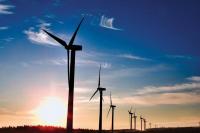
This may change with the introduction of a new player in green energy. Billed as the largest authorised onshore wind farm in Europe, a 1.1 billion Euro project by Czech energy company CEZ in Fantanele and Cogealac, Constanta county, is set to spin this spring. At first 347.5 MW of installed capacity will come onto the power grid, but Dana Duica argues that once Czech energy group CEZ’s entire 600 MW wind project is online in mid 2011, the price for one green certificate will drop to a low of 27 Euro.
“This project will bring back investor confidence in Romania and, together with the implementation of the new law, Romania will be an El Dorado for wind farm developers,” says Duica.
Spanish wind turbine producer Gamesa has developed an interesting strategy in Romania to help boosts its sales. Gamesa is the only turbine producer to set up a company in Romania that also develops wind farms available to anyone willing to buy them. Establishing a company called Carpathian Wind to develop wind projects in Romania using Gamesa turbines, the firm designs mid-scale projects totalling about 300 MW in different stages of development. In this way, Gamesa cuts out the ‘middle man’ and succeeds in selling its technology in an age of fierce competition between turbine manufacturers. “Many newcomers have appeared globally on the turbine market, including the Chinese, who are coming in strong,” says Duica.
In the meantime, Spanish giant Iberdrola has apparently postponed its 1,600 MW installed power capacity wind project in Romania it purchased from local wind developer Rokura. “Judging from the experience of other companies who have experienced financial difficulties due to the crisis, such as Iberdrola, they had to downsize their big projects or put them on hold,” argues Duica.
The EU’s objective is for 20 per cent of the bloc’s total electricity consumption by 2020 to use renewable energy. Up to 30 per cent of Romania’s energy supply already comes from hydro energy, due to large facilities owned by state company Hidroelectrica.
Romania’s goal is to supply 33 per cent of national electricity demand with renewable energy by the end of 2010, 35 per cent by 2015 and 38 per cent by the end of 2020.
Baby steps for solar
The photovoltaic solar energy market is beginning in Romania and only up to 200 KV have been installed across the country – enough power to supply households of about 500 residents.
The most active company is Dutch-based Girasolar Romania, which is working with state-owned Electrica to install photovoltaic panels in Floresti, near Ploiesti. The firm provides equipment and design for photovoltaic solar panel installations.
On average, a household of five needs an installed power capacity of between two to three KV. The investment can reach about 15,000 Euro per household, if the panels are connected to the grid. An ambitious project to install panels on the roof of the Parliament Palace in Bucharest to generate electricity have failed so far. This one building uses the energy of a town of 25,000, which means it would need 15 MW of installed power capacity in photovoltaic panels - a 45 million Euro investment. “The Palace is so large that when the administrator replaced incandescent light bulbs with energy efficient tubes, it reduced power consumption for lighting by 60 per cent,” says Nicolae Floristean, general manager at Girasolar Romania.
The firm plans to invest 15 million Euro in a production facility for an annual capacity of 22 MW photovoltaic panels in Romania. “We are in discussions to see if we could benefit from European funds,” says Floristean.
Low biofuel supply means reliance on imports
All petrol and diesel sold at petrol stations in Romania must contain four per cent bio components – such as fuel from maize, rape and sunflower. This will increase to five per cent from mid-2010 and 20 per cent by 2020, according to EU rules. But local production of bio components is below the market demand, meaning fuel retailers must top up local bio component purchases with imports.
Nevertheless this high demand for bio components mixed with petrol and diesel, to generate bio fuels, has stirred interest from both Romanian and foreign investors, who have poured about 300 million Euro in projects in Romania to produce bio components.
Starting from mid 2010 the local demand for bioethanol - which mixed with petrol generates bio petrol - is estimated to stand at about 350 million litres per year. “About 80 per cent of the bio petrol quantity sold in petrol stations in western Europe contains bioethanol,” says Constantin Dumitru, executive director of Lukoil’s Petrotel refinery in Ploiesti. Lukoil purchased last year bioethanol from the local market and abroad at a price between 1,100 and 1,300 Euro per tonne.
The oil resulting from processing oil seed rape, soy and sunflower - FAME (fatty acid methyl ester)- mixes with diesel to create bio diesel.
Portuguese group Martifer’s 55 million Euro Prio Biocombustibil factory in Lehliu Gara, near Bucharest, covers five per cent of the local demand of bio component for bio diesel - 105,000 tonnes per year. The firm plans to increase its production and has asked the European Investment Bank (EIB) for a 32 million Euro loan as part of a new 93 million Euro investment.
One of the wealthiest Romanians, Ioan Nicolae, who owns a mixed interest group in agriculture, chemicals and hotels Interagro, is wising up to bio fuels. He invested about 100 million Euro in a factory in Zimnicea, Teleorman county, which opened last year. This factory’s production capacity stands at 80,000 tonnes per year of bioethanol. Interagro’s advantage is that it grows the corn which it transforms into fuel.
Adrian Porumboiu, another wealthy Romanian agriculturalist, has also opened a factory to produce bio components in Vaslui county, northeast Romania. Porumboiu has invested around eight million Euro in the Ulerom factory which produced about 22,000 tonnes of bio component in 2008, although it has a capacity of about 60,000 tonnes.
Expur Urziceni, owned by Dutch investment fund Quispel Investment, also started in 2009 to produce bio component for biodiesel, for which it spent about 20 million Euro. The company has partially switched its production from edible oil to oil used to produce biodiesel. The factory’s total production capacity is 100,000 tonnes.
The petroleum price drop from a high of 147 USD in mid-2008 to 30 USD in late 2008 forced some investors to postpone investment in biofuel production. Argus, a Constanta-based producer of edible oil, delayed its ten million Euro investment and told The Diplomat it has no plan to invest in such a factory in 2010.
Russian-owned Lukoil purchased in 2009 between 4,000 and 4,500 tonnes of FAME per month and bioethanol of between 1,500 and 2,200 tonnes per month to produce bio fuels sold in Romania, while Kazakh KMG-owned Rompetrol acquired 66,000 tonnes of bio components for Romania.
All fuel merchandisers in Romania, including Petrom, Rompetrol and Lukoil, acquire bio components. “We intended to invest in our own production facility of bio components, but when we realised how difficult it is to ensure a constant flow of raw material consisting of plants, we decided it was too complicated and we gave up,” says Lukoil’s Dumitru.
US-based Saving Energy Corporation also planned to pour 85 million Euro in building a factory in Romania to produce bio components for bio diesel. “We realised that the feedstock for biofuel plants was very limited worldwide, so we put our plans on hold in USA and Europe, to first find a solution to mitigate the limited feedstock supply,” says Vadim Krifuks, president of Algae Floating Systems, a company set up by the US group to develop the technology to produce microalgae for bio components.
“The biofuel plants in the EU operate on average at a 20 to 30 per cent of their total capacity due to the limited feedstock supply,” says Krifuks. “The successful companies in this sector are those who produce their own feedstock or those who are looking at alternative feedstock such as microalgae.” At present, the technology to produce biofuel derived from algae is still expensive for large scale use.
Threatening the industry is also the social cost of production. There is still a global debate raging over whether using plants such as corn, sunflower and soy for fuel is ethical, when over one billion people in the world suffer from hunger.
PRINT EMAIL
| COMMENTS |
There are 0 comments:
|
|
|
PRINT EMAIL COMMENT
|
SEE ALSO:
July 2009
BUCHAREST While the volume of Bucharest’s modern retail space steadily increases, rents have declined by ten to 20 per cent between January and March 2010 against the same period of 2009, according to real estate consultants DTZ Echinox Salary cuts and VAT hikes will surely be painful - but will they really be gainful?
Crisis report by Claudia Ciobanu The new luxury BMW 5 Series can satisfy those looking for a limousine, a sports car or a cruiser, finds Adrian Ion
Romania should make more use of its advantages as an EU member state at a time of financial crisis, argues French Ambassador to Romania, Henri Paul Austrian-owned oil and gas group Petrom OMV will deliver its green office complex, hosting the company HQ, in Straulesti north of Bucharest by the end of 2010 Against international criticism and the will of President Traian Basescu, the Senate has adopted a raft of laws crippling the EU-backed National Integrity Agency (ANI), leaving the anti-corruption watchdog virtually powerless
|
|