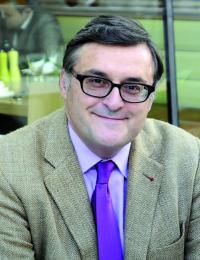
Romania needs to seize greater advantage of EU status
Romania should make more use of its advantages as an EU member state at a time of financial crisis, argues French Ambassador to Romania, Henri Paul July 2010 - From the Print Edition
The financial crisis should make Romania more aware of its role as a member of the European Union, with the responsibilities and advantages that derive from this status, and push the country towards a more dynamic integration, argues France’s Ambassador to Romania, Henri Paul.
The country does not exploit to a sufficient degree the advantages of its EU membership to recover faster from the crisis, according to the Ambassador.
“Romania has been a part of the EU from 2007 and I have the... To continue reading this article you have to be registered
|
|
|
 | | |
|
|
| Daily Info |
|
Smart city is not a fad, it's a necessity In June 2018, the ranking of the most "smart" cities in the world was published. In other words, the most advanced cities in terms of human capital, social cohesion, the econo... |
|
Ondrej Safar, CEZ Group: "Romania can become a hub for international smart solutions providers" "We are already in the digital age, so the upward trend of implementing smart solutions is inevitable in all areas," he tells The Diplomat-Bucharest. "Especially in terms of u... |
|
Telekom Romania, a strong supporter of Smart City development in Romania Just like many other countries in the world Romania is now facing an unprecedented growth of the urban population, which can be both beneficial and detrimental for the society... |
|
In the industrial era, the fight was for finite material resources. Not anymore Now organizations fight and develop themselves for and around their talent.
In a nutshell, getting ahead in today's business world is all about attracting and inspiring an e... |
|
Richard Sareczky, Mol Limo: "We look at expansion locations across CEE including Romania" Consumer mobility behaviour is changing, leading to up to one out of ten cars sold in 2030 potentially being a shared vehicle and the subsequent rise of a market for fit-for-p... |
|
|
|
|
|
|
|
| |
|
|
advertising

advertising

advertising

|
| More on Features |
| Romanian business - Flexibility and agility in a high-potential market  It's anniversary time, with Romania celebrating its national day at a time when its image is coming into serious question at an international level. This month is also an a... It's anniversary time, with Romania celebrating its national day at a time when its image is coming into serious question at an international level. This month is also an a...
|
| Telekom Romania, a strong supporter of Smart City development in Romania  Just like many other countries in the world Romania is now facing an unprecedented growth of the urban population, which can be both beneficial and detrimental for the soci... Just like many other countries in the world Romania is now facing an unprecedented growth of the urban population, which can be both beneficial and detrimental for the soci...
|
| Smart city is not a fad, it's a necessity  In June 2018, the ranking of the most "smart" cities in the world was published. In other words, the most advanced cities in terms of human capital, social cohesion, the ec... In June 2018, the ranking of the most "smart" cities in the world was published. In other words, the most advanced cities in terms of human capital, social cohesion, the ec...
|
| Richard Sareczky, Mol Limo: "We look at expansion locations across CEE including Romania"  Consumer mobility behaviour is changing, leading to up to one out of ten cars sold in 2030 potentially being a shared vehicle and the subsequent rise of a market for fit-fo... Consumer mobility behaviour is changing, leading to up to one out of ten cars sold in 2030 potentially being a shared vehicle and the subsequent rise of a market for fit-fo...
|
| Ondrej Safar, CEZ Group: "Romania can become a hub for international smart solutions providers"  "We are already in the digital age, so the upward trend of implementing smart solutions is inevitable in all areas," he tells The Diplomat-Bucharest. "Especially in terms o... "We are already in the digital age, so the upward trend of implementing smart solutions is inevitable in all areas," he tells The Diplomat-Bucharest. "Especially in terms o...
|
| In the industrial era, the fight was for finite material resources. Not anymore  Now organizations fight and develop themselves for and around their talent.
In a nutshell, getting ahead in today's business world is all about attracting and inspiring a... Now organizations fight and develop themselves for and around their talent.
In a nutshell, getting ahead in today's business world is all about attracting and inspiring a...
|
| True hospitality in Bucharest  Interview with Lior Bebera, General Manager InterContinental Bucharest Interview with Lior Bebera, General Manager InterContinental Bucharest
|
|